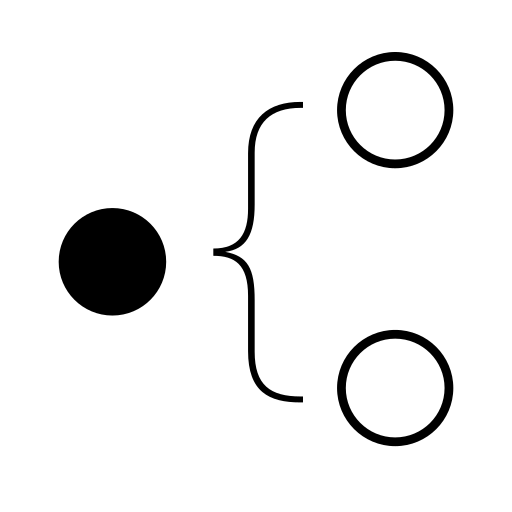

Two smart people. One project. Completely opposite approaches. Sound familiar?
Most conflicts aren’t actually about what people are arguing over. They’re about deeper needs that nobody’s articulating .
The Conflict Resolution Diagram—also called the “Evaporating Cloud” because it makes conflicts disappear—helps you find solutions where both sides actually win. It’s part of the Theory of Constraints developed by Eliyahu Goldratt .
Why Most Conflict Resolution Fails
We treat positions as problems. “I want to redesign the product” vs “I want to keep the current design.” These are just proposals, not the actual issue.
The real conflict lives in the unspoken needs and assumptions underneath .
Conflict Resolution Diagram – The Three-Layer Framework
Work backwards from what’s being argued to what actually matters:
Layer 1: Opposing Demands
What each side is proposing or insisting on. These are typically mutually exclusive (if one happens, the other can’t).
Layer 2: Underlying Needs What each proposal is trying to satisfy. Why does each side believe their approach is necessary?
Layer 3: Shared Goal
What both sides ultimately want to achieve. There’s always a common objective—you just have to find it .
How to Diagram It Out
Map the Surface Conflict
Write down both opposing positions clearly.
- Side A wants: _
- Side B wants: _
Dig for Needs
Ask each side: “What does your proposal give you? What problem does it solve? What requirement does it meet?”
The key question: “In order to achieve what, do you need this?”
Find Common Ground
Ask: “If we satisfy both needs, what larger goal would we achieve?”
This shared objective becomes your North Star for finding alternatives.
Challenge Assumptions
What beliefs make the original demands seem mutually exclusive? Often, unspoken assumptions create false conflicts.
Real Example: The Marketing Budget Battle
Surface Conflict:
- CMO wants: 70% of budget for paid advertising
- Content Lead wants: 70% of budget for content creation
Seems like a zero-sum game .
Underlying Needs:
- CMO needs: Quick, measurable lead generation to hit quarterly targets
- Content Lead needs: Sustainable long-term brand authority and organic traffic growth
Shared Goal:
Both want: Consistent, scalable customer acquisition that supports company growth
Hidden Assumptions:
- CMO assumes: Content takes too long to show results
- Content Lead assumes: Paid ads stop working the moment you stop spending
Win-Win Solution:
Allocate 50% to performance marketing with clear ROAS targets, 30% to content creation with distribution budget attached (so it gets seen), and 20% to experiments testing integrated campaigns. Measure both short-term conversion and long-term organic growth.
Result: Both needs met, shared goal advanced .
When to Use It
Perfect for:
- Team disagreements on strategy or approach
- Resource allocation conflicts
- Design/build trade-offs (speed vs quality, features vs simplicity)
- Cross-functional prioritization battles
- Personal dilemmas where you’re torn between two paths
Critical for:
- Situations where compromise would weaken both positions
- Recurring conflicts that keep resurfacing
- High-stakes decisions affecting multiple stakeholders
The Mindset Shift
Stop thinking “my way vs your way.” Start thinking “our goal” .
When you realize you’re on the same team trying to reach the same destination, the path forward becomes clearer.
Pro Tips
Do This Together
Don’t diagram conflicts alone and present solutions. Work through it collaboratively—the process builds understanding and buy-in.
Stay Curious
If someone’s need seems unreasonable, you haven’t dug deep enough. Keep asking “why does that matter?”
Watch for False Choices
“Either we ship fast or we ship quality” is usually a false dichotomy. Challenge these with: “What would need to be true for us to have both?”
Name the Shared Goal Explicitly
Once you find it, write it down. Reference it throughout the conversation to keep everyone aligned.