Decoding the source code of Human Behavior and Popular Psychology

HumanOS is a high-authority knowledge hub focused on human behavior, popular psychology, and decision-making science. It decodes cognitive biases, psychological effects, and mental heuristics, translating complex behavioral research into clear, actionable insights for leaders, creators, strategists, and innovators. Designed as a practical operating system for understanding people, HumanOS offers deeply relevant, SEO-rich content that helps you leverage behavioral principles to improve communication, design, strategy, culture, and performance.

Cognitive Biases

Cognitive biases are mental shortcuts your brain uses to make sense of the world quickly, but they often twist how you see reality and lead to judgment errors. Instead of carefully weighing all the facts, your mind leans on past experiences, emotions, and familiar patterns, which can cause you to misjudge risks, people, and decisions without even realizing it. Being aware of these built-in thinking habits is the first step to spotting them and making clearer, more balanced choices.

Pseudocertainty Effect: The Illusion of Safety in a World of Conditional Risk

What is the Pseudocertainty Effect?

Pseudocertainty Effect is the tendency to make risk-averse choices if the expected outcome is positive, but make risk-seeking choices to avoid negative outcomes.
Distinction Bias

What is the Distinction Bias?

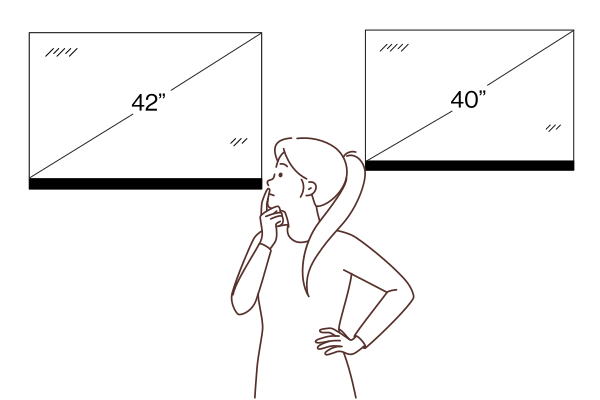
Distinction Bias is our tendency to overweight the differences between options when we evaluate them simultaneously compared to when we experience them separately.
Surrogation Bias

What is the Surrogation Bias?

Surrogation bias is the cognitive and organizational tendency to replace a strategic concept with the metric used to measure it.
Paradox of Choice

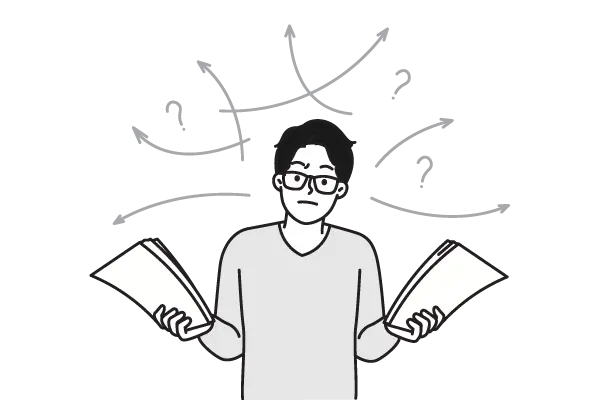
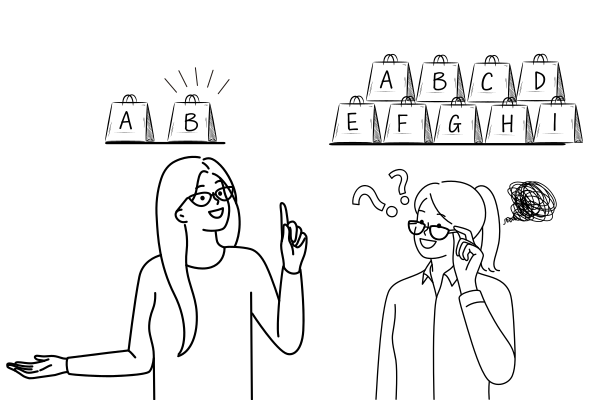
What is the Paradox of Choice? The Processing Overload

Paradox of Choice is a behavioral economics and psychological phenomenon wherein an abundance of options requires more effort to make a decision
Dunning-Kruger Effect

What is the Dunning-Kruger Effect? The Calibration Glitch

Decode the Dunning-Kruger Effect: Discover why this cognitive bias creates an illusion of knowledge and how to fix this calibration glitch in decision-making.
What is Decision Theory?

What is Decision Theory? The Operating System of Human Choice

Discover what decision theory is, how cognitive biases influence our choices, and why humans rarely make perfectly rational decisions. Welcome to HumanOS.
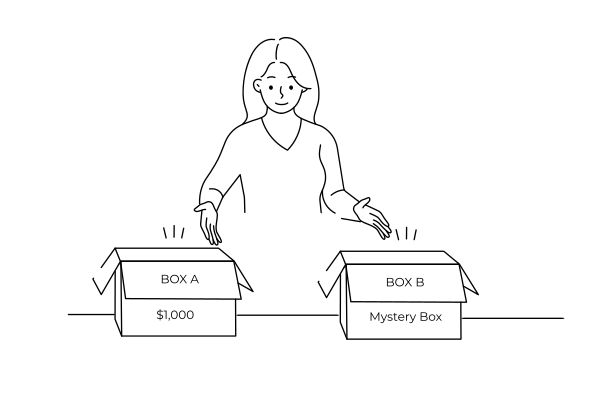
Newcomb’s Paradox

What is Newcomb’s Paradox?

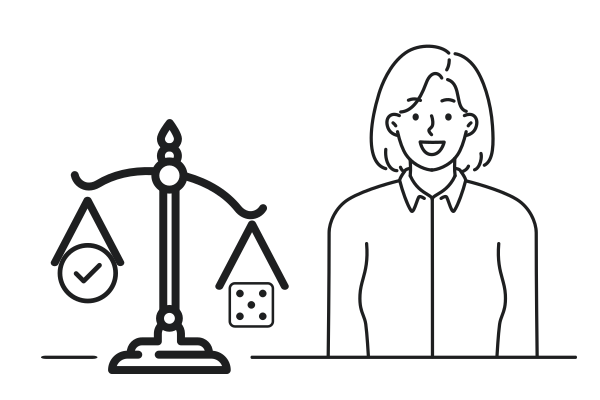
Newcomb’s paradox is a famous philosophical thought experiment about decision-making.
What is the Fundamental Attribution Error?

What is the Fundamental Attribution Error?

Fundamental Attribution Error is when we judge others on their personality of fundamental character, but we judge ourselves on the situation
What is confirmation Bias

What Is Confirmation Bias?

Confirmation bias is a mental filter that leads you to notice, focus on, and believe information that supports what you already think—while completely ignoring or dismissing anything that proves you wrong.

What is HumanOS?

The human mind is not a logic machine. It is an evolved, energy-efficient prediction engine — one that takes shortcuts, relies on patterns, and makes decisions based on emotional signals as much as rational analysis. These are not flaws. They are features, built over hundreds of thousands of years of survival under conditions very different from the ones we now operate in.

The problem is that the cognitive architecture optimized for surviving a predator on the savanna is now being asked to evaluate investment portfolios, design organizational structures, manage global supply chains, and navigate social media. The shortcuts that once kept us alive now introduce systematic errors into our thinking — errors that are predictable, measurable, and once recognized, partially correctable.

HumanOS is the manual that evolution forgot to include. It decodes the core software of human cognition — the biases that distort perception, the paradoxes that reveal the contradictions in rational choice, the heuristics that trade accuracy for speed, the psychological effects that govern how we respond to other people and to systems — and translates all of it into language that is immediately useful for anyone who works with, leads, designs for, or is simply trying to understand other human beings.

This is not pop psychology. Every concept in HumanOS is grounded in peer-reviewed behavioral science, decision theory, and cognitive research. But it is written for practitioners, not academics. The goal is not to make you more knowledgeable about psychology. The goal is to make you a more precise thinker, a better decision-maker, and a sharper reader of human behavior in real situations.

Cognitive Biases — The Glitches in the Operating System

A cognitive bias is a systematic pattern of deviation from rational judgment. The word “systematic” is what matters most here — these are not random errors. They are predictable errors, produced by the same mental shortcuts in the same types of situations, across different people, cultures, and contexts. That predictability is what makes them both dangerous and manageable.

Cognitive biases emerge from heuristics — the mental rules of thumb your brain uses to process the approximately 11 million bits of information it receives every second while consciously attending to only around 50. Without compression, without shortcuts, cognition would be paralyzed. The cost of that compression is distortion — a gap between reality as it is and reality as your mind constructs it.

Understanding cognitive biases does not make you immune to them. Research consistently shows that knowing about a bias and correcting for it in real-time are two very different things — the Dunning-Kruger Effect applies even to people who know what the Dunning-Kruger Effect is. What understanding does provide is a second-order awareness: the ability to design better systems, build better feedback loops, create decision-making structures that account for the distortions you cannot fully eliminate from your own mind.

The biases catalogued in HumanOS span the major domains of human judgment: how we perceive information (Confirmation Bias, Availability Heuristic), how we evaluate other people (Fundamental Attribution Error, Halo Effect), how we make decisions under uncertainty (Anchoring Bias, Action Bias), how we assess our own knowledge (Dunning-Kruger Effect, Overconfidence Bias), and how we respond to choice itself (Paradox of Choice, Status Quo Bias). Together they form a map of where human judgment reliably goes wrong — and where, with better design and deliberate practice, it can be recalibrated.

Currently in HumanOS — Cognitive Biases: Confirmation Bias · Anchoring Bias · Dunning-Kruger Effect · Fundamental Attribution Error · Action Bias · Affect Heuristic · Paradox of Choice · Surrogation Bias · Availability Heuristic · Status Quo Bias · Optimism Bias · In-group Bias · Sunk Cost Fallacy · Framing Effect · Bandwagon Effect

Paradoxes — Where Logic Breaks Down

A paradox is a statement, situation, or problem that appears self-contradictory but may nonetheless be true — or that reveals a genuine tension between two equally valid logical positions. Paradoxes are not failures of thinking. They are pressure tests. They appear at the edges of our conceptual frameworks and mark the places where our models of reality are incomplete.

In the context of human behavior and decision science, paradoxes are particularly revealing because they expose the contradictions at the heart of rational choice theory — the assumption that human beings are consistent, logical agents who always act in their own best interest. The paradoxes documented in HumanOS demonstrate systematically that this is not the case, and that the deviations from rationality are not random noise but structural features of how minds work.

The Paradox of Choice reveals that more options do not produce more satisfaction — beyond a threshold, additional choices increase cognitive load, elevate opportunity cost regret, and reduce decision quality and post-decision happiness. The rational assumption is that more choice is always better. The behavioral reality is that choice architecture — how options are structured and presented — matters more than the total number of options available.

Newcomb’s Paradox is one of the most contested problems in decision theory — a thought experiment that forces a choice between two defensible but mutually incompatible decision-making strategies: expected utility maximization versus causal dominance reasoning. Its relevance extends far beyond philosophy: it maps directly onto real-world situations involving pre-commitment strategies, principal-agent problems, and AI alignment.

The Paradox of Tolerance — originally formulated by Karl Popper — poses the question of whether a tolerant society must tolerate intolerance, or whether tolerating intolerance ultimately destroys tolerance itself. In organizational and cultural contexts, this paradox appears in questions about how teams handle dissent, how platforms govern harmful content, and how institutions balance openness with integrity.

The Productivity Paradox describes the empirically observed phenomenon where significant investment in technology — particularly information technology — fails to produce measurable gains in productivity. First identified in the 1980s during the PC revolution, it has since reappeared with each major technology wave and is currently live again in debates about whether enterprise AI investment is translating into measurable output gains.

The Planning Fallacy — a paradox of self-knowledge — describes the consistent human tendency to underestimate the time, cost, and risk of future actions while overestimating the benefits, even when the person making the plan has direct experience of similar failures in the past. It is not corrected by intelligence or expertise. It is corrected by reference class forecasting and external accountability structures.

Paradoxes in HumanOS are presented not as puzzles to be solved but as maps of conceptual territory that requires more careful navigation than ordinary thinking provides. Each entry asks: what does this paradox reveal about the limits of our models, and what adjustments does it demand from our decision-making systems?

Currently in HumanOS — Paradoxes: Paradox of Choice · Newcomb’s Paradox · Paradox of Tolerance · Planning Fallacy · Abilene Paradox · Simpson’s Paradox · The Productivity Paradox · Braess’s Paradox · Moravec’s Paradox

Psychological Effects — The Hidden Forces Shaping Behavior

If cognitive biases are glitches in individual reasoning, psychological effects are the patterns that emerge when minds interact with environments, systems, and other minds. These are the forces that operate beneath the surface of social behavior — governing how authority shapes compliance, how environment shapes identity, how scarcity shapes desire, and how observation changes the thing being observed.

The Halo Effect describes the tendency to let one positive attribute of a person, product, or organization color the perception of all their other attributes. A well-designed product feels more reliable. A physically attractive person seems more intelligent. A charismatic founder makes investors overestimate business fundamentals. The Halo Effect is not a quirk of unsophisticated minds — it operates in hiring decisions, product reviews, investor due diligence, and performance evaluations at every level of organizational sophistication.

The Pygmalion Effect — also known as the Rosenthal Effect — documents the phenomenon where higher expectations from an authority figure lead to improved performance from the person being evaluated. The inverse, the Golem Effect, describes how low expectations produce deteriorating performance. Both have profound implications for leadership, education, design, and any context where one person’s belief about another shapes the conditions under which that other person operates.

The Bystander Effect reveals that the presence of others reduces individual likelihood of intervention in an emergency — counterintuitively, more witnesses correlate with less help. Diffusion of responsibility is the mechanism: each individual assumes someone else will act. Understanding the Bystander Effect is essential for designing organizational accountability structures, crisis response systems, and any environment where collective action problems need to be resolved.

The Hawthorne Effect describes how people modify their behavior when they know they are being observed — a finding with direct implications for performance management, research design, and the ethics of monitoring in workplaces. In an era of algorithmic management and productivity tracking software, the Hawthorne Effect is no longer a historical curiosity. It is an active design challenge.

The Zeigarnik Effect — the psychological tendency to remember interrupted or incomplete tasks more vividly than completed ones — explains the cognitive pull of unfinished projects, cliffhangers, open loops in narrative, and the addictive architecture of streaming platforms and social media feeds. Designers and strategists who understand the Zeigarnik Effect understand why completion matters as much as initiation.

The Baader-Meinhof Phenomenon (Frequency Illusion) explains why, after you learn a new word or concept, you suddenly seem to encounter it everywhere. The concept was always present — your attentional filter simply was not calibrated to surface it. For strategists and innovators, this effect explains both the danger of recency bias and the value of deliberately expanding conceptual vocabulary.

Currently in HumanOS — Psychological Effects: Halo Effect · Pygmalion Effect · Bystander Effect · Hawthorne Effect · Zeigarnik Effect · Baader-Meinhof Phenomenon · Placebo Effect · Mere Exposure Effect · Spotlight Effect · Pratfall Effect

Heuristics — The Shortcuts That Run Your Thinking

A heuristic is a mental shortcut — a rule of thumb that allows the brain to make fast, low-effort decisions without performing full analytical processing. Heuristics are not mistakes. In most everyday contexts, they produce results that are good enough, fast enough, under conditions where perfect information is unavailable and time is limited. The problem is that in high-stakes, unfamiliar, or deliberately constructed environments, heuristics produce systematic errors.

Daniel Kahneman’s framework of System 1 and System 2 thinking provides the architecture: System 1 is fast, automatic, heuristic-driven, and largely unconscious. System 2 is slow, deliberate, analytical, and effortful. Most of our decisions are made by System 1, with System 2 engaged only when System 1 signals uncertainty or when the decision is flagged as important enough to warrant the cognitive cost.

Heuristics documented in HumanOS include:

The Availability Heuristic — judging probability by how easily examples come to mind. Plane crashes feel more dangerous than car crashes not because the statistics support this but because plane crashes are more vivid, more reported, and more emotionally salient. The availability heuristic governs risk perception, insurance purchasing behavior, policy responses to rare events, and the media’s disproportionate influence on what feels dangerous versus what is dangerous.

The Representativeness Heuristic — judging probability by how closely something resembles a prototype or stereotype. A person who fits the mental image of a scientist is judged more likely to be a scientist, regardless of base rates. This heuristic drives stereotyping, pattern recognition in data analysis, and the investor tendency to back founders who “look like” previous successful founders.

The Affect Heuristic — making judgments based on current emotional state rather than objective analysis. If something feels good, it is judged as low risk and high benefit. If it feels bad, it is judged as high risk and low benefit — regardless of the actual risk-benefit profile. The Affect Heuristic is the mechanism behind fear-based and aspiration-based marketing, and the reason that emotional state at the time of decision is one of the most powerful predictors of decision outcome.

Satisficing — the tendency to select the first option that meets a threshold of acceptability rather than continuing to search for the optimal option. Coined by Herbert Simon, satisficing is not a failure of ambition. It is a rational response to the real cost of search. Understanding when to satisfice and when to optimize is one of the core competencies of effective strategic decision-making.

Currently in HumanOS — Heuristics: Availability Heuristic · Representativeness Heuristic · Affect Heuristic · Anchoring Heuristic · Satisficing · Recognition Heuristic · Take-the-Best Heuristic · Fluency Heuristic

Decision Science — The Architecture of Choice

Decision science is the interdisciplinary study of how choices are made — pulling from economics, psychology, neuroscience, statistics, and philosophy to build models of human decision-making that are more accurate than the rational actor model that dominated economic theory for most of the twentieth century.

The fundamental insight of behavioral decision science — established through decades of experimental work by researchers including Kahneman, Tversky, Thaler, Ariely, and Simon — is that human beings are not rational actors who maximize expected utility. We are predictably irrational actors whose deviations from rationality follow consistent, mappable patterns. That predictability is what makes the field practically useful: if irrationality were random, there would be nothing to design against. Because it is systematic, it can be accounted for, designed around, and in some cases, corrected.

Decision Theory — the formal framework for analyzing how decisions should be made under conditions of uncertainty — provides the mathematical scaffolding. Expected utility theory, game theory, prospect theory, and Bayesian decision theory each offer different models of rational choice and different accounts of where and why human behavior departs from those models.

Prospect Theory, developed by Kahneman and Tversky, replaced expected utility theory as the dominant descriptive model of human decision-making under risk. Its central findings — that losses loom larger than equivalent gains (loss aversion), that people evaluate outcomes relative to a reference point rather than in absolute terms, and that the probability weighting function is non-linear — have reshaped economics, finance, product design, and policy.

Nudge Theory, developed by Thaler and Sunstein, applies behavioral decision science to the design of choice architecture — the environments in which decisions are made. The core insight is that default options, framing, ordering, and social proof cues powerfully influence choices without restricting them. Nudge is the design layer on top of decision science: where the science describes how people decide, nudge asks how environments should be structured to help people decide better.

HumanOS covers decision science not as an academic subject but as a practitioner’s toolkit — applicable to product design, organizational structure, communication strategy, investment decisions, and the design of any system in which human choice plays a role.

Currently in HumanOS — Decision Science: Decision Theory · Prospect Theory · Nudge Theory · Expected Utility Theory · Loss Aversion · Mental Accounting · Temporal Discounting · The Planning Fallacy · Newcomb’s Paradox · Satisficing

Why This Matters More Than Ever

We are living through the most consequential period in the history of human decision-making infrastructure. Artificial intelligence systems are being embedded in hiring, lending, medical diagnosis, content curation, criminal sentencing, and military targeting. Algorithmic systems are shaping what billions of people see, believe, and feel on a daily basis. The organizations designing these systems are staffed by people whose cognitive biases, heuristics, and psychological blind spots are being encoded — at scale — into systems that will affect billions of people who never consented to be part of the experiment.

At the same time, the pace and complexity of the decisions that individuals, teams, and organizations are being asked to make is accelerating beyond the calibration of the cognitive hardware that evolution provided. The people navigating this environment most effectively are those who understand — with precision and humility — how their own minds work, where they are most likely to fail, and what structural conditions produce better collective thinking.

HumanOS is not a self-improvement project. It is an operational upgrade. Every bias decoded, every paradox mapped, every heuristic named is a small increase in the gap between stimulus and response — the gap in which better judgment lives.

The goal is not perfect rationality. The goal is directed imperfection: knowing where you are most likely to go wrong, designing your environment and your processes to account for it, and building the kind of self-aware thinking culture that treats cognitive error as an engineering problem rather than a moral failure.

That is what the source code of human behavior, read carefully, makes possible.

Enable Notifications OK No thanks