

Pseudocertainty Effect: The Illusion of Safety in a World of Conditional Risk
It is 2 AM and you are scrolling through the terms of a new financial product. You have already bought into one layer of the offer — a fixed-rate guarantee on the first portion of your investment. The second portion is variable, exposed to market risk. But because the first part feels secure, you barely process the risk in the second. You close the app feeling, vaguely, that your money is safe.
It is not. You have just been processed by one of the most underexplored cognitive biases in behavioral economics: the Pseudocertainty Effect. You have experienced certainty that was never real — and your brain accepted it as if it were.
What is Pseudocertainty Effect
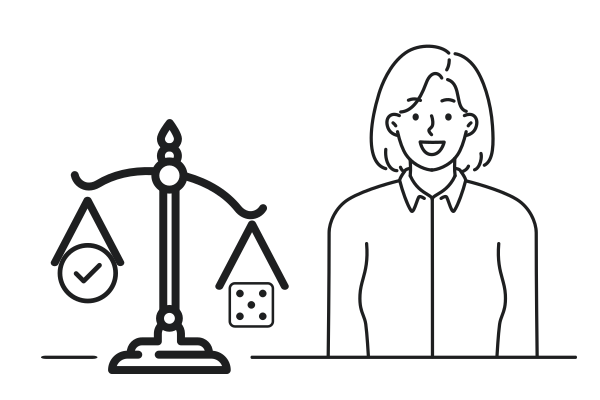
The Pseudocertainty Effect, identified by Daniel Kahneman and Amos Tversky in their foundational work on Prospect Theory, describes a specific cognitive asymmetry: people treat outcomes that are framed as certain more favorably than outcomes of equivalent expected value that are framed as probable — even when the “certainty” is only certain within a conditional structure that is itself uncertain.
In other words: if an outcome is presented as guaranteed assuming a prior event occurs, the brain processes the guarantee as if the prior condition didn’t exist. The conditional gets collapsed. The certainty is pseudo — it was never unconditional — but the emotional weight of the “certain” framing dominates the decision.
The OS Analogy
The Human OS runs a dedicated risk-processing module that operates on a simple architecture: certain outcomes are treated as resolved (they leave the anxiety queue); probable outcomes remain active (they continue consuming processing cycles). This is efficient — resolved items don’t need to be monitored.
The Pseudocertainty Effect is a parsing error in this module. When an outcome is framed as “certain,” the module marks it as resolved and releases the associated cognitive resources — even when the “certainty” is embedded inside a conditional that is still highly uncertain. The brain reads the word “guaranteed” and issues a resolution signal before fully parsing the conditions under which the guarantee applies.
This is not irrationality in the classical sense. It is the predictable output of a system that processes framing before it processes logic.
Also read : What is the Surrogation Bias?
Why It Exists
The cognitive architecture that produces the Pseudocertainty Effect was almost certainly adaptive. In environments of pervasive, multi-source risk, the ability to mentally segregate resolved threats from active ones was critical for effective action. A brain that kept all risks in continuous active processing would be paralyzed. The resolution mechanism — marking certain outcomes as closed — allowed the human OS to focus attention on genuine, unresolved threats.
The problem emerges in complex, multi-layered risk environments — exactly the kind that modern financial, technological, and institutional systems produce. When certainty is conditional and conditions are compounded, the resolution-at-first-certain-signal heuristic produces systematic miscalculation.
Where It Shows Up Today
Insurance products are architecturally designed — sometimes intentionally, sometimes not — to trigger the Pseudocertainty Effect. “Your home is fully protected” activates the certainty module. The forty-seven categories of exclusion printed in 8-point font activate nothing. The brain resolves the risk on the headline.
In AI-assisted decision tools, the Pseudocertainty Effect is a growing concern. When an AI system presents a recommendation with a high confidence score — “92% certainty” — users frequently treat this as near-certain, collapsing the 8% residual risk as if it were noise. But in high-stakes domains (medical diagnosis, legal outcomes, financial forecasting), an 8% error rate is not noise. It is a meaningful probability of catastrophic misclassification.
In political communication, pseudocertainty is the architecture of most guarantees. “Your taxes will not increase” is presented as a certainty; the conditions under which this holds — stable economic conditions, no legislative changes, no definition shifts — are not. The certainty is processed; the conditionality is not.
In UX and onboarding design, “Your data is 100% secure” statements activate the certainty module and prevent users from engaging with the actual security trade-offs embedded in the service. The pseudocertainty doesn’t protect users; it prevents them from being protected.
The Hidden Cost
The Pseudocertainty Effect is particularly dangerous because it operates in the domain where the stakes are highest: risk. Systematic miscalculation of risk is not an abstract error — it produces real exposure in financial, medical, legal, and personal safety domains.
The bias also has an asymmetric quality: it tends to cause overconfidence in protection and underpreparation for failure. People who experience pseudocertainty don’t just make one wrong decision; they often fail to build the contingency systems — emergency funds, backup plans, alternative strategies — that would have protected them if the pseudocertainty had been processed accurately as conditional probability.
Design Insight
For designers and communicators, the Pseudocertainty Effect demands a discipline of conditional transparency. Every guarantee, protection claim, or certainty signal in an interface carries the risk of triggering false resolution in users. The ethical and practical design response is to make conditionality legible — not buried in fine print, but architecturally integrated into the moment the certainty claim is made.
This is not about removing confidence from communication. It is about structuring confidence claims so that the conditional structure is part of the primary message, not an afterthought. “Your core investment is protected if markets stay above X” is less powerful than “Your investment is guaranteed” — but it produces a user who has actually processed the risk landscape they are operating in.
Designing against pseudocertainty is designing for informed consent. It is, ultimately, designing for trust that survives contact with reality.
How to Work With It (Not Against It)
Decompose conditional certainties. When you encounter a guarantee or certainty claim, explicitly ask: “Under what conditions does this hold? What breaks this?” Writing out the conditions forces the brain to process the conditionality rather than collapsing it.
Translate probabilities into frequencies. Instead of “92% certain,” think “8 in 100 cases, this is wrong.” Frequency framing keeps residual risk cognitively active rather than letting the “92%” trigger a resolution signal.
Design red-path scenarios. In planning and strategy: deliberately model the failure case of your “certainties.” If the guaranteed outcome doesn’t materialize, what is the next move? Preparing the red path keeps the conditionality of certainty active.
Audit your interfaces for resolution triggers. Review every certainty claim in your product or communication. For each one: does the user actually understand the conditions? Or have you inadvertently produced pseudocertainty?
Closing Insight
The Pseudocertainty Effect is ultimately a story about framing power. The same risk, presented as certain-within-conditions or as genuinely probable, produces radically different cognitive responses — and radically different behaviors. The language of certainty is among the most powerful cognitive levers available to designers, marketers, politicians, and communicators.
With that power comes a responsibility that the HumanOS framework takes seriously: to frame honestly, to make conditionality visible, and to design for users who understand the actual risk landscape they inhabit.
Pseudocertainty feels like safety. Real safety requires that you know the difference. Closing Insight
The Pseudocertainty Effect is ultimately a story about framing power. The same risk, presented as certain-within-conditions or as genuinely probable, produces radically different cognitive responses — and radically different behaviors. The language of certainty is among the most powerful cognitive levers available to designers, marketers, politicians, and communicators.
With that power comes a responsibility that the HumanOS framework takes seriously: to frame honestly, to make conditionality visible, and to design for users who understand the actual risk landscape they inhabit.
Pseudocertainty feels like safety. Real safety requires that you know the difference.