
Why Your Solutions Keep Missing the Mark
Ever feel like you’re treating symptoms instead of solving actual problems? You fix one thing, and three more issues pop up. That’s because most of us jump straight to solutions without understanding what’s really broken.
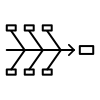
The Ishikawa Diagram—also called the Fishbone Diagram because it literally looks like a fish skeleton—helps you dig past surface-level issues to find the real culprits .
What Ishikawa Diagram Actually Does
Think of it as a visual autopsy of your problem. Created by Japanese quality control expert Kaoru Ishikawa, this tool maps out all potential causes of an issue across different categories, so you can see the full picture before rushing to fix anything .
It’s particularly powerful for complex, multi-layered problems where the obvious answer is rarely the right one.
How to Build Your Fishbone
Start with the Problem Statement
Write your problem on the right side of a page (or left—your choice). Draw a horizontal line pointing to it. This is your “spine.”
Identify Major Categories
Add diagonal lines branching off your spine. These represent different categories that might contribute to your problem. Use these six classics or create your own:
- People – Skills, motivation, communication gaps
- Process – Workflows, procedures, inefficiencies
- Technology – Tools, equipment, software limitations
- Environment – Physical workspace, culture, external factors
- Materials – Resources, quality, availability
- Measurement – Data accuracy, tracking methods
Ask “Why?” Relentlessly
For each category, brainstorm specific causes. Add them as smaller bones branching off each category line. Keep asking “Why is this happening?” until you can’t dig any deeper.
Analyze and Prioritize
Once your diagram is complete, step back. Look for patterns. Which causes appear most frequently? Which have the most sub-causes? Which are easiest to verify or test?
Also read : Productive Thinking Model
Advanced Applications of the Ishikawa Diagram
1. Tailoring Categories to Your Industry While the classic categories (People, Process, Technology, Environment, Materials, Measurement) are incredibly versatile, you can adopt specific frameworks tailored to your field to ensure you cover the right ground:
- Manufacturing (The 6Ms): Machine, Method, Material, Manpower, Measurement, Milieu (Mother Nature/Environment).
- Service & Administration (The 4Ps or 4Ss): Policies, Procedures, People, Plant/Technology; or Surroundings, Suppliers, Systems, Skills.
- Marketing (The 8Ps): Product, Price, Place, Promotion, People, Process, Physical Evidence, Performance.
2. Pairing with the “5 Whys” Technique The Fishbone Diagram works best when it acts as the foundation for the 5 Whys. Once you identify a primary cause on a “bone,” you don’t stop there. You ask “Why did this happen?” up to five times to drill down to the fundamental root cause, adding smaller “twigs” to your diagram.
3. The Danger of “Brainstorming Bias” A common pitfall when building an Ishikawa Diagram is relying purely on assumptions rather than empirical data. Teams often populate the diagram with what they believe is causing the problem (e.g., “The team is unmotivated”) without measuring it. A well-executed diagram should be treated as a map of hypotheses; each node must be verified with real data or observation before action is taken.
Real-World Example
Problem: Your startup’s mobile app has a 60% drop-off rate at signup.
Categories identified: User Experience, Technical Issues, Marketing
Possible root causes uncovered:
- UX: Too many form fields, unclear value proposition, poor onboarding flow
- Technical: Slow load times on Android, crashes on older devices, third-party auth failures
- Marketing: Wrong audience targeting, misleading ad copy creating false expectations
Action: Instead of redesigning everything, you test the quickest fixes first—reducing form fields from 12 to 4 and fixing the Android performance issue. Drop-off rate falls to 35% .
When to Use It
Perfect for: Product failures, team performance issues, customer complaints, process breakdowns, recurring technical bugs, project delays
Not ideal for: Simple problems with obvious causes, time-sensitive emergencies requiring immediate action
Pro Tips
- Do this as a team exercise—different perspectives reveal hidden causes
- Don’t judge ideas while brainstorming; capture everything first
- Use data to validate your suspected causes before implementing solutions
- Keep the diagram visible during solution implementation to stay focused
Frequently Asked Questions (FAQs)
Q1: What is the primary difference between a Fishbone Diagram and a Flowchart?
A: A flowchart maps out a sequence of events, steps, or processes in chronological order. A Fishbone Diagram is a cause-and-effect tool that categorizes potential reasons behind a single, specific problem. Flowcharts are for visualizing how something happens, while Fishbone diagrams are for figuring out why something is failing.
Q2: Are the standard categories (like People, Process, Technology) mandatory?
A: No, they are highly flexible starting points. If a category doesn’t apply to your specific problem, you can remove it. Alternatively, if your issue requires a highly specific category (e.g., “Third-Party API Integrations” for a software bug), you should create a custom branch for it.
Q3: How do we know when we’ve found the actual “root cause”?
A: You’ve likely reached a root cause when asking “Why?” again yields a cause over which you have absolutely no control, or when the answer loops back to a systemic constraint. More practically, if you remove or fix that specific cause and the primary problem permanently goes away (without creating new issues), you’ve found the root.
Q4: Can the Ishikawa Diagram be used in Agile or software development environments?
A: Absolutely. It is frequently used during Agile Retrospectives. When a sprint fails to deliver or a critical bug reaches production, the team can map out the Fishbone diagram to evaluate if the breakdown was due to tooling (Technology), vague acceptance criteria (Process), or capacity issues (People).
Q5: What should we do if a potential cause fits into multiple categories?
A: Place it wherever it feels most relevant, or simply place it in both categories if it helps your team visualize the issue better. The goal of the Ishikawa Diagram is to generate discussion and uncover the root issue, not to perfectly categorize every variable.
Q6: Is this tool only for analyzing negative outcomes or problems?
A: While traditionally used for defect analysis and problem-solving, it can also be reverse-engineered for positive outcomes. You can place a goal (e.g., “Increase user retention by 20%”) at the head of the fish, and use the branches to brainstorm the necessary ingredients (factors) required to achieve that success.