

The Death of Apps: Why AI Agents are Killing your Smartphone Apps
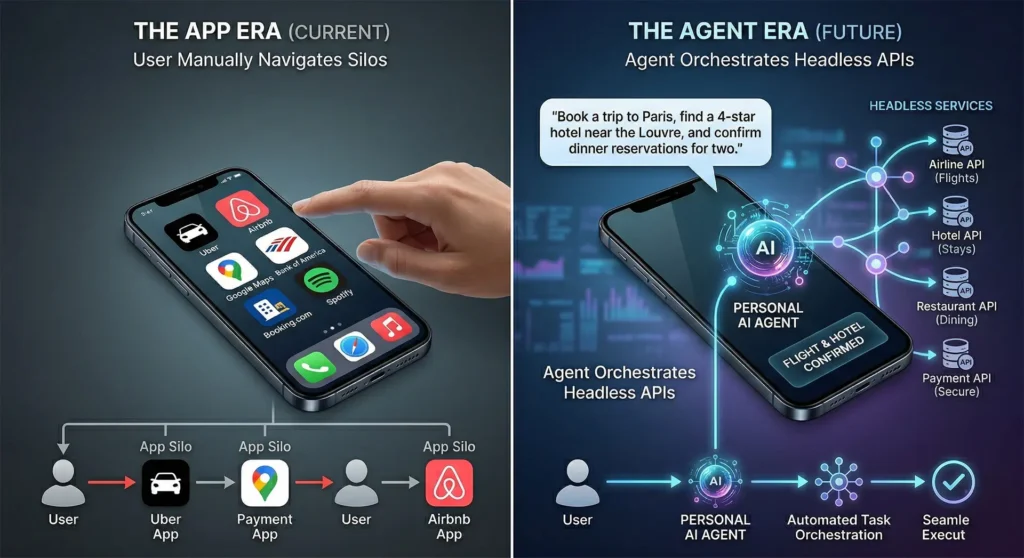
Since the launch of the first app stores in 2008, our digital lives have been defined by the “grid.” We organize our tasks, entertainment, and communications into neat little squares of glass. We tap, we scroll, we authenticate, and we navigate through isolated software silos. If you want to book a vacation, you open a flight app, switch to a hotel app, cross-reference with a calendar app, and finalize payment in a banking app.
But this era of human-computer interaction is rapidly approaching its twilight. As tech leaders and visionaries have recently noted—including Nothing CEO Carl Pei, who declared at SXSW 2026 that apps will disappear “whether you like it or not”—we are standing on the precipice of a post-app world.
The future of the smartphone is not about giving you better tools to do the work yourself. It is about handing the work over to a unified, autonomous entity: the AI agent.
Here is a glimpse into how the devices of tomorrow will operate, why the app ecosystem as we know it will collapse into the background, and what your daily life will look like when your smartphone finally becomes smart enough to act on your behalf.
The Shift from Reactive Chatbots to Autonomous Agents
To understand the death of apps, we first have to understand the difference between generative AI (like the early versions of ChatGPT) and Agentic AI.
A chatbot is reactive. You ask it a question, and it generates text. If you ask it to plan a trip, it will give you a lovely itinerary, but you still have to open your browser, find the flights, input your credit card, and book the hotels yourself.
An AI agent, on the other hand, is proactive and autonomous. It possesses three critical capabilities that standard chatbots lack:
- Persistent Memory: It remembers your preferences across days, weeks, and years without needing to be reminded.
- Tool Calling: It can plug directly into external services, APIs, and databases.
- Sequential Reasoning: It can break a massive goal (“Plan my anniversary trip to Kyoto”) into dozens of micro-tasks, execute them one by one, verify its own work, and correct course if it encounters an error.
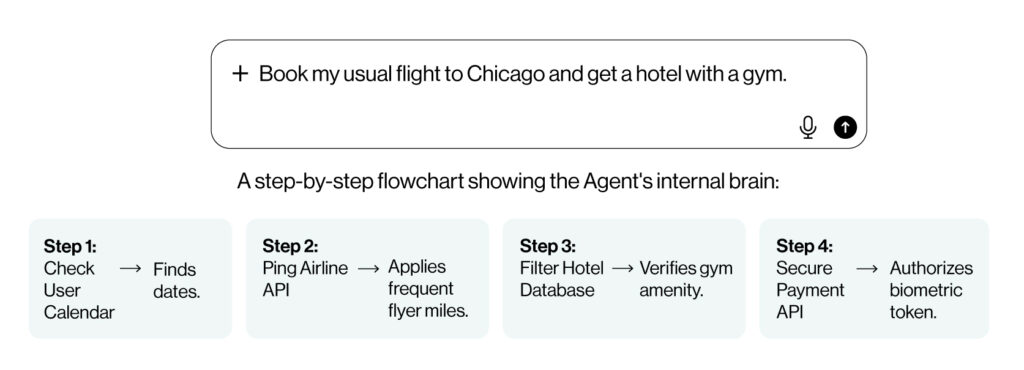
In an agent-first world, you don’t use software; you state an intent. You tell your device, “Book my usual aisle seat for the Chicago conference next month, and make sure the hotel has a gym.” The agent accesses your calendar to find the dates, pings airline APIs to secure the ticket, filters hotel databases for gym facilities, applies your frequent flyer miles, and completes the transaction.
Why death of apps? You never opened a single app.
Also read : Algorithmic Management: The Middle Management Paradox when Algorithms Track Human Performance
The Intent-Driven Operating System
In the near future, the operating system (OS) itself will be the only “app” you truly interact with. Rather than acting as a simple launcher for third-party software, the OS will function as an omniscient digital concierge.
The Death of the UI (User Interface)
Currently, companies spend millions designing frictionless graphical user interfaces (GUIs). In the future, visual interfaces will take a backseat to natural language—both voice and text—supplemented by contextual awareness. Your phone will know where you are, what you are looking at (via camera vision), and what your immediate goals are.
Apps Become “Headless” Services
This doesn’t mean companies like Uber, Airbnb, or Spotify will go bankrupt. Instead, they will undergo a massive structural shift. They will transition from being consumer-facing destinations to being backend services.
Instead of fighting for space on your home screen, these companies will fight to be the preferred API that your AI agent calls when you say, “Get me a ride to the airport.” The consumer app interface will become a relic, utilized only for highly specific, visually demanding tasks or by developers. For the average user, the “app” will be entirely invisible.
A Glimpse into Tomorrow: A Day in the Life
To fully grasp the magnitude of this shift, let’s look at what a typical Tuesday might look like in a mature, agent-driven ecosystem.
7:00 AM: You wake up. There are no static notifications clogging your lock screen. Instead, your personal agent provides a synthesized, conversational briefing. It tells you that your 10:00 AM meeting was pushed back, so it automatically adjusted your morning alarm to give you an extra 30 minutes of sleep.
9:15 AM: While you are making breakfast, your agent notes that it’s your mother’s birthday next week. It suggests three gift options based on her recent online browsing and your budget. You say, “Get her the gardening set and have it shipped to her house.” The transaction is completed instantly.
1:00 PM: You are working on a complex project. You tell your device, “Cross-reference last quarter’s sales data with the new marketing spend, and generate a brief for the team.” Your agent autonomously accesses your company’s CRM, pulls the data into a spreadsheet, analyzes the trends, drafts an email, and waits for your verbal approval to hit send.
6:30 PM: You are walking home. Your smart glasses (powered by the same core agent) see a pair of shoes in a boutique window. You tap the frame of your glasses and say, “Find these in my size and order them.” The agent uses visual search to identify the shoes, scans global inventory, finds the best price, applies a coupon code, and purchases them.
At no point during this day did you tap a grid icon, scroll through a feed to find an inbox, or manually type in a password. Your device stopped being a portal to the digital world and became an active participant in your physical one.
The Hidden Mechanics: How It Will Actually Work
For this seamless future to become a reality, the underlying architecture of mobile computing is currently undergoing a radical transformation. A truly agentic smartphone requires three massive technological leaps:
Capability-Based APIs
Today’s apps are built for human thumbs and eyeballs. Tomorrow’s digital economy must be built for machine-to-machine communication. Services must offer “capability APIs”—small, composable actions that machines can trigger reliably. If a restaurant’s reservation system only exists as a website that requires a human to click a calendar widget, it will be left behind.
Delegated Authorization
If an AI agent is going to act on your behalf, it needs a wallet and an ID. We will see the rise of “capability tokens.” You won’t just log into an app; you will issue your agent a highly specific, restricted mandate. For example, you might authorize your agent to spend up to $100 per week on groceries, but require biometric approval (like a fingerprint or retina scan) for any purchase over that amount.
The Agentic Economy
Eventually, your personal AI agent will begin negotiating with corporate AI agents. When you need a refund for a delayed flight, your agent will autonomously ping the airline’s customer service agent. The two AIs will communicate in milliseconds, exchanging policy details and flight logs, resolving the dispute, and depositing the money into your account before you even realize the negotiation took place.
Form Follows Function: The Hardware Revolution
If we no longer need to poke at rows of colorful icons, the very shape of our devices will change. The glass slab we have carried for the last two decades was designed to accommodate graphical interfaces. When the interface disappears, the hardware is liberated.
- The Disappearing Screen: While screens won’t vanish entirely—we will always want to watch movies, look at photos, and review visual data—they will stop being the primary input method.
- Ambient Computing Hubs: The “phone” of the future may shrink to the size of a credit card, acting merely as a powerful, localized compute hub that stays in your pocket.
- Wearable Peripherals: You will interact with this hub through discreet wearables: lightweight AR glasses that overlay information onto the real world, advanced wireless earbuds that whisper real-time translations and context into your ear, or smart rings that detect micro-gestures.
The device will melt into your environment. Technology will finally become ambient—always present, entirely capable, but visually unobtrusive.
The Transition Phase: Coexistence and the Ecosystem Wars
History proves that technological transitions are rarely binary. Apps will not evaporate overnight. Instead, we will enter a messy, fascinating transitional period marked by heterogeneity.
In the immediate future, we will see a turf war between localized agents and unified OS agents. App developers will try to build their own isolated AI agents to keep you trapped in their specific ecosystems. You will likely have a “banking agent,” a “shopping agent,” and a “travel agent.”
However, user friction will eventually force consolidation. Consumers will not want to manage ten different autonomous agents. They will demand a single, omnipotent “Meta-Agent” (controlled by the OS, such as Apple Intelligence or Google’s system-level Gemini integration) that orchestrates all the underlying specialized agents. The companies that control the hardware and the operating system will ultimately win this war, reducing third-party apps to mere sub-routines of the master AI.
The Hurdles: Security, Trust, and Relinquishing Control
A future where AI manages your life sounds utopic, but it comes with profound risks. Handing over the keys to your digital existence requires an unprecedented level of trust, and the industry must solve several critical hurdles before the app-less phone goes mainstream.
Hallucinations with Real-World Stakes
When a chatbot makes a mistake today, it gives you a funny, incorrect poem. When an autonomous agent makes a mistake in 2028, it might accidentally wire $5,000 to the wrong vendor or cancel your health insurance. The margin for error must drop to absolute zero.
Agent Governance and Audit Trails
If an agent makes a decision on your behalf, you must be able to see why. OS developers will need to build robust “agent audit trails”—a black box flight recorder for your phone that allows you to review the exact logic, API calls, and reasoning the AI used to take a specific action.
Data Sovereignty
An agent that knows you intimately is a massive privacy liability. The future of AI relies heavily on “on-device processing.” Rather than sending your highly personal data to a centralized cloud server, the device’s neural processing units (NPUs) will handle the AI computation locally. Your secrets must stay in your pocket.
Conclusion: The Ultimate Concierge
The disappearance of the smartphone app is not a loss; it is an evolution. We have spent the last twenty years learning how to speak the language of computers—learning how to navigate their menus, understand their folder structures, and adapt to their interfaces.
The rise of the AI agent marks the moment computers finally learn to speak our language.
By replacing static apps with dynamic, autonomous agents, we will reclaim countless hours of our lives currently lost to digital friction. The technology will fade into the background, leaving us with something much more powerful: an invisible, tireless assistant dedicated entirely to navigating the friction of the modern world on our behalf.