


The Myth of Innovation as Methodology
The Innovation begins with Human Thinking and isn’t something separate from your work that requires a special process or department. It’s woven into how you question, simplify, imagine, articulate, and conclude from the very beginning. When we treat innovation as an external add-on rather than an innate human capacity, we distance ourselves from the very thinking that sparks genuine breakthroughs.
Five Cognitive Traits You Already Possess
Consider this radical proposition: what if the most powerful innovation capabilities aren’t learned in workshops but are already hardwired into your brain? As a designer who has spent years studying how ideas become impact, I’ve observed that transformative innovation consistently emerges from five fundamental cognitive traits we all possess from birth.
Curiosity drives discovery. A sharper question opens more doors than any brand-new process . When PayPal emerged, it wasn’t because someone followed a 12-step innovation framework—someone asked why sending money had to be so needlessly hard . The most important question in innovation isn’t “how” or “what”—it’s “why”. Without understanding why, you risk building sophisticated solutions to problems that don’t exist. Curiosity is the seed that begins every creative journey.
Simplification creates clarity. Every complex problem contains a simple truth waiting to be found. IDEO’s Clean Team project in Ghana could have deployed high-tech toilet systems, but instead created a simple service that worked within local constraints . The power wasn’t in complexity—it was in stripping away everything unnecessary to reveal what actually mattered. This art of simplifying complexity through smart shortcuts—what we might call heuristics—transforms overwhelming challenges into manageable solutions.
Imagination expands possibility. Innovation starts with human imagination, not technological capability. Behind every digital breakthrough, there’s a mind sparking fresh ideas, navigating uncertainty, and envisioning what doesn’t yet exist. Design thinking draws on logic, imagination, intuition, and systemic reasoning to explore possibilities and create outcomes that benefit end users . Imagination is the fuel for creativity and innovation, allowing you to prototype futures before committing resources.
Articulation transforms ideas into action. The ability to express a concept in its shortest, most convincing form determines whether it dies on a whiteboard or changes the world. An insight that informs, inspires, and remains memorable requires precise articulation . This power of precision—being laconic in your communication—ensures your breakthrough doesn’t get lost in translation. Instead of saying “people find medication tracking hard,” say “people want medication management to feel effortless, not like another task.” This subtle shift in eloquence defines both challenge and emotional need .
Concluding with logic grounds innovation. Raw creativity without logical structure creates chaos, not change. The deductive ability to test assumptions, follow logical flow, and ground decisions in critical thinking anchors your innovations in reality . When IDEO redesigned the shopping cart, they didn’t stop at imaginative ideas—they prototyped, tested, and refined based on logical assessment of what actually worked. This logical flow transforms wild possibilities into workable solutions.
The CHILD Framework: Your Innate Thinking Made Systematic
These aren’t random capabilities—they’re interconnected cognitive traits that form a natural creative thinking system. This is precisely what the CHILD Creative Thinking Framework articulates: a return to your innate thinking abilities, refined into a practical approach anyone can apply.
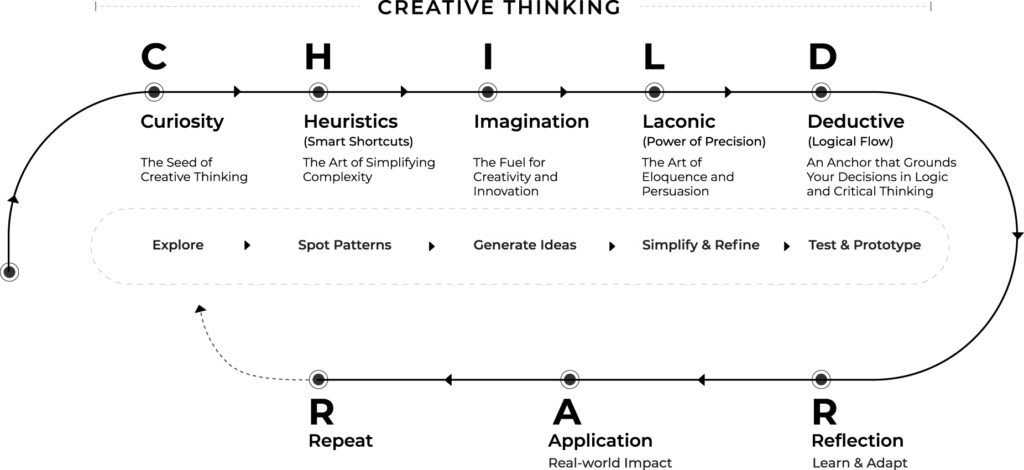
C for Curiosity—the seed of creative thinking that drives exploration and questioning.
H for Heuristics—smart shortcuts that simplify complexity through pattern recognition.
I for Imagination—the fuel for creativity that generates breakthrough ideas.
L for Laconic—the power of precision that refines and persuades.
D for Deductive—logical flow that tests, prototypes, and grounds your thinking.
The framework recognizes that you don’t need to learn innovation from scratch. You need to reconnect with and sharpen the thinking patterns that already exist within you. It’s not about importing external methodologies but about awakening internal capacities that have been suppressed by conventional thinking.
Learn more about the CHILD Creative Thinking Framework here
From Birthright to Business Advantage
Every child demonstrates these five cognitive traits naturally. They ask endless questions (curiosity). They find intuitive shortcuts through adult complexity (heuristics). They imagine elaborate worlds from simple objects (imagination). They describe their thoughts with refreshing directness (laconic precision). They follow their own logic fearlessly (deductive reasoning).
Then something happens. We’re taught to follow established processes, defer to expertise, and mistrust our own thinking. We replace curiosity with compliance, heuristic simplicity with unnecessary complication, imagination with pragmatism. We learn to inflate our articulation and abandon logical independence.
Innovation begins when we reclaim these cognitive birthright abilities and apply them intentionally to the challenges we face. It’s not about becoming someone different—it’s about becoming yourself again, but with strategic awareness.
The Competitive Advantage of Human Thinking
In an era obsessed with artificial intelligence and automation, human thinking isn’t becoming obsolete—it’s becoming more valuable. Technology can process data, but it cannot replace the curiosity that asks transformative questions. It can execute algorithms, but cannot create the heuristic shortcuts that simplify in ways that create meaning. It can generate variations, but cannot imagine with purpose. It can communicate information, but cannot articulate with laconic resonance. It can compute probabilities, but cannot conclude with the deductive wisdom born of experience.
Innovation that matters—innovation that creates lasting value, solves real problems, and resonates deeply—begins and ends with distinctly human thinking. Design thinking is human-centered precisely because understanding people’s challenges leads to better solutions . The CHILD framework simply makes these innate human capabilities systematic and repeatable.
As a Human Thinker Your Innovation Journey Starts Now
As a Human Thinker, Innovation begins with Human Thinking. You don’t need permission to innovate. You don’t need a certification or a framework license. You need to trust the thinking you were born with and apply it deliberately.
Start with curiosity. Question your assumptions. Ask why things are the way they are, and why they couldn’t be different. Use heuristics to simplify relentlessly until you reach the essential truth. Imagine possibilities beyond current constraints. Articulate your insights with laconic precision and punch. Conclude with deductive logic that grounds your innovations in reality.
This isn’t abstract philosophy—it’s practical methodology grounded in how humans naturally think when we haven’t been trained out of it. The combination of these five cognitive traits creates an innovation engine more powerful than any corporate framework because it’s authentic, sustainable, and infinitely adaptable.
The Handbook for Awakening Your Creative Thinking
For those ready to systematically develop these innate abilities, “A CHILD in Us: The Creative Thinking Handbook” provides the comprehensive guide to reclaiming and refining your natural innovative thinking. It’s not about learning something new—it’s about rediscovering something essential.
Your thoughts about “Why Innovation Begins With Human Thinking”
Why Innovation Begins With Human Thinking
Also read : Cognitive Evolution in the AI Era: Are We Losing Our Intelligence?