

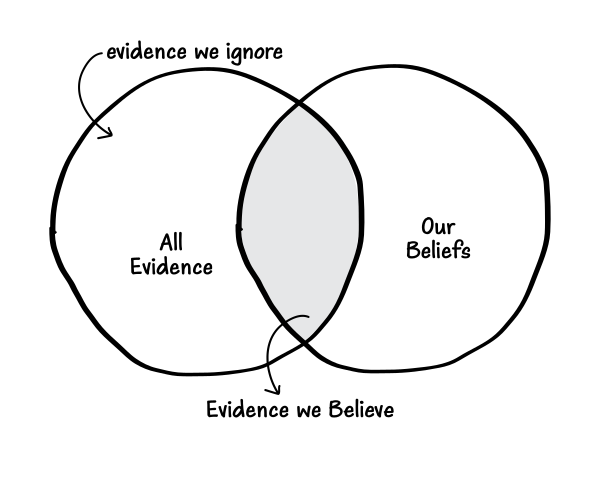
Confirmation bias is a mental filter that leads you to notice, focus on, and believe information that supports what you already think—while completely ignoring or dismissing anything that proves you wrong.
What Is Confirmation Bias? The Psychology of the “I Knew It!” Moment
We like to think of ourselves as objective judges of reality. We believe that when we encounter new information, we weigh the evidence fairly and then decide what’s true.
But let’s be honest. Have you ever been in an argument and only Googled questions that supported your side? Have you ever ignored a red flag in a new relationship because you “just knew” they were the one? Or have you scrolled past a news article that challenged your political views, muttering that it was “fake” before you even read the first paragraph?
If that sounds familiar, don’t worry: You’re not closed-minded. You’re just human. You’ve just been caught in the grip of Confirmation Bias.
Wait, The What-Bias?
Let’s break down the jargon.
- Confirmation = Seeking out or interpreting evidence that fits a pre-existing belief.
- Bias = A distortion in the way we perceive the world.
Put them together, and you get Confirmation Bias: A mental shortcut where your brain acts like a high-end security guard for your ego. It lets in all the “friendly” information that agrees with you and slams the door on any “hostile” facts that might suggest you’re wrong.
Think of it as your brain’s internal “Echo Chamber.” Instead of asking the difficult question, “Is my belief actually true?” your brain asks the easier one: “Where can I find more proof that I’m right?”
Why Do We Do This?
Your brain hates being wrong. In fact, finding out you’re wrong can feel physically painful (it triggers the same parts of the brain as physical threats).
From an evolutionary perspective, consistency was a survival trait. Changing your mind takes massive amounts of cognitive energy. By sticking to what we already “know,” our brains save power and maintain a stable sense of identity. It’s much more comfortable to live in a world where you are always right than in one where you have to constantly update your software.
Confirmation Bias in Action
This bias isn’t just about politics; it’s the silent architect of your daily life. Here is how it shows up:
1. The “Algorithm” Trap Your social media feed is a confirmation bias machine. Because you “like” things you already agree with, the algorithm shows you more of them. Eventually, you start to think everyone agrees with you because you never see a dissenting opinion. You aren’t seeing the world; you’re seeing a mirror.
2. The First Impression “Glue” If you meet someone and decide they are “arrogant” in the first five minutes, your brain will spend the rest of the night looking for evidence to prove it. If they check their phone, you think, “How rude.” If they tell a joke, you think, “What a show-off.” Meanwhile, you ignore the fact that they held the door open for three people and offered to pay for the drinks.
3. The “Lucky” Ritual Ever have a “lucky” shirt or a specific routine before a big game? If you wear the shirt and win, you remember it forever as “proof.” If you wear the shirt and lose, you blame the referee or the weather. You count the hits and ignore the misses to keep the belief alive.
The Dark Side of the Bubble
While it feels good to be right, Confirmation Bias makes us blind to the truth.
It’s why investors hold onto losing stocks (they only read the “bullish” news). It’s why doctors sometimes misdiagnose patients (they stick to their first hunch and ignore conflicting symptoms). When we stop looking for the truth and start looking for “proof,” we stop growing.
How to Outsmart Your Own Brain
You can’t delete this bias, but you can fact-check it. The next time you feel that surge of “I knew it!” or the urge to dismiss a different opinion—pause. Ask yourself:
“What evidence would it take to change my mind?”
If your answer is “nothing,” you aren’t thinking; you’re just confirming. To break the cycle, go out of your way to find the “No.” Seek out the smartest person who disagrees with you and try to understand why.
Your beliefs should be a compass, not a cage. Don’t be afraid to let them change.