

What is Newcomb’s Paradox? The Decision Theory Dilemma Breaking Our Brains
Newcomb’s paradox is a famous philosophical thought experiment about decision-making. You must choose between two boxes of money, but your choice has already been predicted by an incredibly accurate AI. Do you take one box to align with the AI’s prediction of a massive payout, or do you take both boxes because the money is already placed? This philosophy paradox explained reveals the deep conflict between causal logic (actions cause outcomes) and evidential logic (actions reveal what kind of outcome is likely), shedding light on modern algorithms, human rationality, and behavioral economics
You Are Standing in Front of Two Mysterious Boxes…
You are standing in front of two mysterious boxes.
Box A is made of clear glass. Inside, you can plainly see a crisp, freshly printed $1,000 bill.
Box B is opaque. You can’t see inside it. It either contains $1,000,000, or it contains absolutely nothing.
A mysterious entity—let’s call it the Predictor—stands beside the boxes. The Predictor could be an alien, a god, or, more likely for our era, an incredibly advanced Artificial Intelligence. This Predictor has been analyzing human behavior for years. It knows your search history, your psychology, your genetic predispositions, and exactly how your brain processes risk. In fact, its predictions about human behavior are basically 100% accurate.
The Predictor tells you the rules of the game:
“You have two choices. You can either take only Box B, or you can take both Box A and Box B. However, yesterday, I predicted what you were going to do. If I predicted you would take only Box B, I put $1,000,000 inside it. If I predicted you would get greedy and take both boxes, I left Box B completely empty.”
The Predictor then walks away. The money is already in the boxes. The physical state of the universe is set.
So, what do you do? Do you take one box, or do you take both?
Welcome to the headache-inducing world of Newcomb’s paradox.
The Thought Experiment: A Rational Decision Making Paradox
To truly understand what Newcomb’s paradox is, we need to break down the sheer infuriating nature of the choices in front of you.
Here is a simple diagram explanation of the two boxes to visualize the setup:
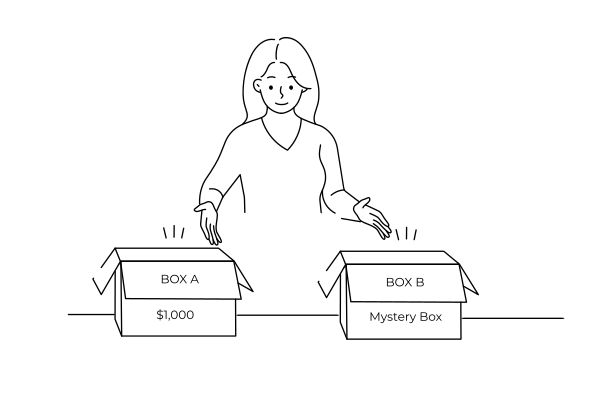
YOUR OPTIONS:
Option 1: Take ONLY Box B.
Option 2: Take BOTH Box A and Box B.
THE CATCH:
If the Predictor guessed you’d take Option 1 -> Box B has $1,000,000.
If the Predictor guessed you’d take Option 2 -> Box B has $0.
(The prediction was made yesterday. The boxes cannot change now.)
This isn’t a trick question where the Predictor is hiding under the table with a remote control. The money was either placed in Box B yesterday, or it wasn’t.
If you are like most people, you immediately lean heavily toward one of the two choices, and you probably think anyone who chooses the other option is completely out of their mind.
The One-Boxers: “I’m taking only Box B. The Predictor is almost always right. Everyone who takes both boxes walks away with a measly thousand bucks. Everyone who takes just Box B walks away a millionaire. I want to be a millionaire. I’m taking Box B.”
The Two-Boxers: “I’m taking both boxes. The prediction was made yesterday. The money is either in Box B right now, or it isn’t. My choice today cannot reach back in time and change what the Predictor did yesterday. If the million is there, I get $1,001,000. If it isn’t, I at least get $1,000. Taking both boxes mathematically guarantees me $1,000 more than whatever I would have gotten otherwise!”
Both of these arguments are flawlessly logical. Both make perfect sense. And yet, they completely contradict each other. This is why it is considered the ultimate decision theory paradox.
Why Newcomb’s Paradox Breaks Our Brain
The reason this thought experiment is so fiercely debated is that it pits two dominant schools of logical reasoning against each other. It shows us that our internal “operating system” for making choices is deeply divided.
Let’s look at the two underlying frameworks fighting for control in your brain.
Causal Decision Theory (The Two-Boxer’s Religion)
Causal Decision Theory says that rational choices should be based on cause and effect. You should only make a decision if your action directly causes a better outcome.
Imagine you are watching a pre-recorded football game, and your favorite team is losing. You know that whenever you wear your lucky jersey, your team tends to win. Does putting the jersey on now change the outcome of a game that was recorded yesterday? Of course not. That’s magical thinking.
For a Causal Decision Theorist, taking one box in Newcomb’s paradox is magical thinking. Your action today cannot cause the million dollars to appear in the box yesterday. Therefore, the only rational, cause-and-effect choice is to take both boxes, securing an extra $1,000.
Evidential Decision Theory (The One-Boxer’s Gospel)
Evidential Decision Theory, on the other hand, says you should choose the action that provides the best evidence that a good outcome will happen.
Imagine a real-world example: A doctor tells you that waking up with a headache is strongly correlated with a rare, deadly brain disease. However, taking a simple aspirin prevents the headache. Does taking the aspirin cure the disease? No. But waking up without a headache is excellent evidence that you don’t have the disease.
For an Evidential Decision Theorist, choosing only Box B provides overwhelming evidence that you are the type of person the Predictor put the $1,000,000 aside for. You aren’t trying to change the past; you are just trying to place yourself in the statistical group of people who become millionaires.
What This Paradox Reveals About Human Thinking
At its core, Newcomb’s paradox isn’t just a quirky math problem. It is a mirror reflecting the deepest tensions in human psychology and behavioral science.
Rationality vs Intuition
We like to think of humans as rational actors who maximize utility. But what happens when logic dictates an outcome that intuitively feels like a massive loss? The two-box argument is perfectly logical, yet it results in getting only $1,000 while the “irrational” one-boxers become millionaires. It forces us to ask: Is it better to be strictly logical, or is it better to be rich?
Free Will vs Determinism
This behavioral economics paradox fundamentally attacks our illusion of free will. If an AI can predict your choice with near-perfect accuracy yesterday, did you ever actually make a choice today? If our brains are just biological algorithms that respond predictably to inputs, then our “free choice” to take one box or two is just an illusion.
Predictability of Human Decisions
Humans are incredibly predictable. We fall victim to cognitive biases, we follow habitual patterns, and our strategic thinking is often deeply flawed. Newcomb’s paradox forces us to confront the reality that if someone (or something) understands our internal biases well enough, they can front-run our decisions.
Real-World Analogies: Where the Paradox Lives
You might be thinking, “This is a fun philosophy thought experiment, but I’m never going to meet an alien handing out million-dollar boxes.”
True. But the underlying mechanics of this rational decision making paradox happen every single day.
The Prisoner’s Dilemma
Imagine you and an accomplice are arrested. You are put in separate rooms. If you both stay silent, you both get 1 year in jail. If you both betray each other, you both get 5 years. But if you betray him and he stays silent, you go free and he gets 10 years (and vice versa).
Causal reasoning says: “No matter what he does, I’m better off betraying him. If he’s silent, I go free. If he betrays, I get 5 years instead of 10.” Evidential reasoning says: “My partner and I think exactly alike. My choice to stay silent is evidence that he will also choose to stay silent. Therefore, I should stay silent.”
Climate Policy and Voting
Why should any single country dramatically cut carbon emissions if it hurts their economy, knowing that their single action won’t stop global warming if other massive nations keep polluting? Causally, it makes no sense. But evidentially, acting responsibly is evidence that a global consensus of responsible action is occurring.
The same applies to voting. Causally, your single vote will almost certainly never tip a national election. Staying home saves you an hour of time. But evidentially, your decision to vote is strong evidence that people in your demographic are voting, which does win elections.
Insurance Decisions
Imagine a genetic test that tells you if you have a gene that causes both a love for smoking and a high risk of lung cancer. If you have the gene, quitting smoking won’t lower your cancer risk (in this hypothetical scenario). If you don’t have the gene, smoking won’t give you cancer. Causally, you might as well smoke if you enjoy it! But evidentially, choosing not to smoke provides evidence to yourself that you don’t possess the deadly gene.
The AI Angle: Why Newcomb is the Paradox of the Future
When Robert Nozick first popularized this problem, the “Predictor” was purely hypothetical. Today, the Predictor lives in your phone.
Predictive AI, machine learning algorithms, and big data modeling are turning Newcomb’s paradox into a reality. Algorithms already predict what you will buy, what videos will keep you scrolling, and how you will vote.
Imagine applying for a mortgage. An AI has analyzed thousands of data points about your life. It has already made a prediction about whether you will default on a loan, and it has set your interest rate accordingly.
You want to take an action today (like paying off a small credit card) to get a better rate. But the AI has already factored in whether you are the type of person who pays off a credit card right before applying for a loan. You are trapped in a loop of trying to outsmart a system that has already priced in your attempt to outsmart it.
As AI models get better at modeling human behavior, we will increasingly find ourselves playing games against Predictors. The question of whether we should act causally or evidentially will move from philosophy departments to Silicon Valley boardrooms.
What Do Philosophers Think?
The paradox was introduced to the philosophical community in 1969 by Harvard philosopher Robert Nozick (though it was originally formulated by a physicist named William Newcomb, hence the name).
When Nozick published it, he noted something fascinating: “To almost everyone, it is perfectly clear and obvious what should be done. The difficulty is that these people seem to divide almost evenly on the problem, with large numbers thinking that the opposing half is just being silly.”
For decades, philosophers have fiercely debated the issue.
David Lewis, a titan of 20th-century philosophy, was a staunch Two-Boxer, arguing that we cannot let the illusion of backward causation dictate our actions.
Other thinkers argue that decision theory is ultimately about maximizing utility. If the One-Boxers consistently walk away with a million dollars while the Two-Boxers walk away with a thousand, then any theory that tells you to take two boxes is fundamentally broken. As the famous philosophical rebuttal goes: “If you’re so smart, why ain’t you rich?”
So What Should You Actually Choose?
If you are hoping for a definitive answer, you are going to be disappointed. That is the nature of a true philosophy paradox explained—it has no clean resolution.
If you choose One Box, you are prioritizing the outcome. You are acknowledging that the universe (or the AI) is smarter than you, and you are playing the statistical odds. You are accepting a world where evidence trumps cause and effect.
If you choose Two Boxes, you are prioritizing agency. You are asserting that the past is unchangeable and that a rational human must always take the action that definitively improves their physical reality in the present moment, regardless of spooky predictions.
The debate continues because both answers capture something deeply true about how we navigate the world. We live in a physical universe governed by cause and effect, but we navigate it using social, psychological, and statistical evidence.
The HumanOS Insight: Why This Matters
At HumanOS, we view the human mind as an operating system. Like any OS, it has base code, processing frameworks, and occasional bugs.
Newcomb’s paradox acts as a stress test for human cognition. It reveals a fundamental bug in our OS: our inability to seamlessly reconcile what we cause with what we can predict.
Understanding this paradox is crucial because it highlights our behavioral biases. When we make decisions—whether negotiating a salary, investing in the stock market, or dealing with predictive algorithms—we are constantly bouncing between causal and evidential reasoning. Sometimes we are overly focused on what we can control (causing us to miss the bigger picture), and sometimes we are overly focused on patterns and predictions (causing us to engage in magical thinking).
By recognizing these two warring factions inside your brain, you can become a sharper, more deliberate decision-maker. You stop simply reacting to the boxes in front of you, and you start questioning the nature of the game itself.
Also read : What is Confirmation Bias
Also read : What is CHILD Framework