

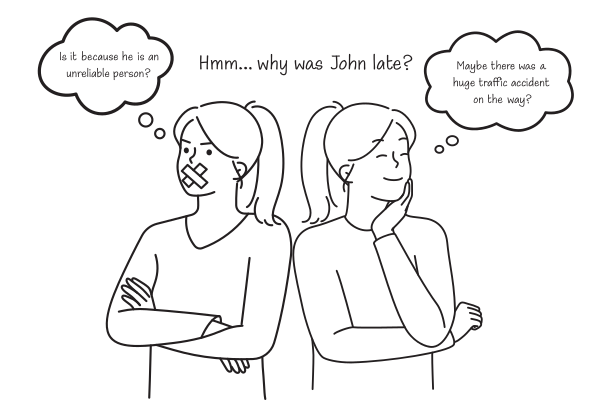
What is the Fundamental Attribution Error? The Core Glitch
What is the Fundamental Attribution Error? – Fundamental Attribution Error is when we judge others on their personality of fundamental character, but we judge ourselves on the situation
In cognitive psychology and behavioral economics, the Fundamental Attribution Error (often linked to correspondence bias) is defined as our tendency to overemphasize personal characteristics and ignore situational factors when judging the behavior of others.
Conversely, when evaluating our own behavior, we execute the exact opposite routine: we blame the environment and context while completely ignoring our own character flaws. In software terms, when another user’s program crashes, we assume their code is garbage (internal attribution). When our program crashes, we blame the server connection, the hardware limits, or a recent forced update (external attribution).
The Two Modes of Attribution Theory
To fully understand this bug, we need to look at how the Human OS assigns “cause” to an event based on Attribution Theory:
- Internal (Dispositional) Attribution: This is the assumption that a person’s behavior is directly driven by their personality, character, inherent motives, or internal beliefs. (Example: “The project manager missed the deadline because he is lazy, unorganized, and incompetent.”)
- External (Situational) Attribution: This is the assumption that a person’s behavior is heavily dictated by their environment, temporary circumstances, or external pressures. (Example: “I missed the deadline because the client changed the scope at the last minute and our software server went down.”)
The FAE glitch occurs because the human brain defaults to Internal Attribution for others, and External Attribution for ourselves.
The Architecture of the Bug: Why Our Brains Code It This Way
You might wonder why such a flawed piece of legacy code made it into the final evolutionary build of human psychology. Why do we consistently make this analytical error? Cognitive psychologists and evolutionary biologists point to a few core reasons for this hardcoded setup:
1. Processing Bandwidth Conservation (Cognitive Load)
Analyzing someone’s environment takes a massive amount of cognitive processing power. To accurately judge a situation, you have to gather external data, understand the person’s background, evaluate their current stressors, and calculate how those hidden factors influence their actions. It is computationally heavy. Assigning a simple label like “they are just a toxic person” requires almost zero RAM. It is a lazy, but highly energy-efficient, shortcut for the brain.
2. The Perceptual Salience Glitch (Visual Focus)
When you observe someone else, they are the most prominent, active object in your visual and cognitive field. The environment and their invisible stressors fade into the background. Therefore, your brain assigns the cause of the action to the focal point: the person. When you are the one acting, you cannot see yourself; you only see the environment, the obstacles, and the circumstances around you. Therefore, your brain assigns the cause of your actions to the environment.
3. The Need for Predictable UI (Illusion of Control)
Humans crave a predictable user interface in life. If we believe people act primarily because of who they are (their stable character traits), it gives us the comforting illusion that we can predict what they will do next. If we admit that people are largely the victims of chaotic, ever-changing, unpredictable circumstances, the world suddenly becomes a much scarier, uncontrollable place. The FAE gives us a false sense of security.
The Actor-Observer Bias: A Related Sub-Routine
When debugging the Fundamental Attribution Error, it is critical to understand a closely related sub-routine called the Actor-Observer Bias. This is the specific cognitive mechanism that creates the double standard.
When you are the actor in a given situation, you have full “admin access” to your own internal server. You know your intentions, your sleep schedule, your current anxiety levels, and the exact circumstances you are facing. Because you have all this rich background data, you easily and accurately attribute your failures to the situation.
When you are the observer, you are locked out of the other person’s internal server. You don’t have access to their background data, their hidden chronic pain, or the fight they had with their spouse that morning. Lacking data, your brain runs a predictive text algorithm, filling in the gaps with assumptions about their character.
Real-World System Failures Caused by Fundamental Attribution Error
If left unpatched, the Fundamental Attribution Error can wreak havoc on organizational behavior and interpersonal dynamics. Here is how the symptoms manifest across different high-stakes applications.
In Corporate Leadership: The “Bad Employee” Illusion
A senior manager notices that a historically reliable, top-performing sales executive’s numbers have plummeted over the last quarter.
- The Glitch Response: The manager assumes the employee has “lost their hunger,” is getting lazy, or is disengaged from the company culture. They issue a harsh performance improvement plan (PIP).
- The Reality: The employee is going through a brutal custody battle, their territory was recently reshuffled, and the new CRM software the company deployed is full of bugs, causing workflow bottlenecks.
- The Impact: The harsh, character-attacking PIP demotivates the employee further, destroying trust and potentially causing the company to lose a highly valuable asset over a temporary, solvable situational issue.
In UX and Product Design: The “Stupid User” Fallacy
A product developer builds a new SaaS application, but the analytics show that users keep abandoning the onboarding process at step three.
- The Glitch Response: The developer thinks, “These users are impatient, illiterate, and just don’t know how to follow simple, logical instructions.”
- The Reality: The “Next” button is poorly contrasted and hidden below the fold on mobile devices, and the API call takes 12 seconds to load, making users think the app froze.
- The Impact: The company bleeds revenue and churns customers because the creator blamed the user’s inherent character instead of auditing the system’s environment.
In Interpersonal Relationships: The “Uncaring Partner” Trap
Your spouse forgets to pick up the dry cleaning on the way home, despite promising they would.
- The Glitch Response: You immediately assume they are selfish, they don’t value your time, and they are incapable of keeping commitments.
- The Reality: They were bombarded with an emergency client escalation at 4:55 PM, leaving work in a state of high cortisol and tunnel vision, causing their working memory to drop the dry cleaning task.
Also read : What Is Confirmation Bias?
How to Patch the Bug: Debugging Your Daily Judgments
You cannot permanently uninstall the Fundamental Attribution Error—it is hardwired into the baseline code of human nature. However, you can consciously install behavioral patches that interrupt the automatic processing and force your brain to run a more accurate, high-fidelity analysis.
Patch 1: Implement the “Three Alternative Causes” Protocol
Whenever you find yourself judging someone’s character negatively or feeling sudden resentment, hit pause. Force your brain to generate three purely situational, external reasons for their behavior.
- Observation: My coworker ignored me in the hallway.
- Alternative 1: They are deep in thought trying to solve a complex coding issue.
- Alternative 2: They just received terrible personal news and are completely dissociated.
- Alternative 3: They weren’t wearing their contacts and literally could not focus on my face. The simple act of forcing your brain to brainstorm external factors instantly reboots your empathy software.
Patch 2: The “Shoe-Shifting” Emulator
Deliberately run a simulation placing yourself in the other user’s environment. Ask yourself: “If I were facing the exact same financial pressures, impossible deadlines, and environmental stressors as they are right now, is it highly probable I would react the exact same way?” If you are honest with yourself, the answer is almost always yes.
Patch 3: Assume Positive Intent (Default to Trust)
Change your default security settings. In the absence of concrete data, make the active choice to assume that the other person is acting with good intentions but is being constrained by bad circumstances. It is mathematically better to be occasionally naive than to live in a constant state of cynical, inaccurate paranoia.
Patch 4: Ask Diagnostic, Contextual Questions
Instead of diagnosing the person, diagnose the situation. If a team member is failing, do not ask, “Why are you underperforming?” Instead ask, “What roadblocks are currently in your way, and how can I help remove them?” This shifts the focus from character assassination to environmental optimization.
Conclusion: Upgrading to Human OS 2.0
The Fundamental Attribution Error is a cheap mental shortcut that costs us dearly in empathy, effective leadership, and rational decision-making. By understanding how this psychological bug operates under the hood, we can catch ourselves before we jump to toxic conclusions.
Upgrading your internal software requires patience, self-awareness, and deliberate effort. But by prioritizing context over character, you will build better products, lead more highly engaged teams, and foster healthier, more resilient relationships. Consider your system successfully patched.
What is the Fundamental Attribution Error?
Learn what is a CHILD Creative Thinking Framework