

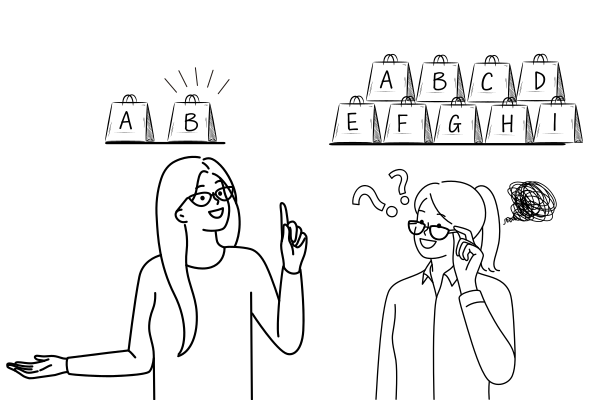
What is the Paradox of Choice? The Processing Overload
When More Becomes Less
It is a Tuesday evening. You sink into your couch, open a streaming app, and prepare to unwind with a movie. Forty-five minutes later, you have scrolled past hundreds of titles, watched a dozen trailers, and ultimately turned off the television in mild frustration, opting to aimlessly scroll social media instead.
This is not a failure of willpower. It is a system crash.
We live in an era defined by infinite inventory. From the endless aisles of Amazon to the swiping mechanics of modern dating apps, we are told that maximum choice equals maximum freedom. Yet, instead of feeling liberated, we feel exhausted. Why does more choice feel like less freedom? The answer lies in the architecture of the mind: a processing overload in the human cognitive system where more options increase friction instead of freedom.
What is the Paradox of Choice?
At its core, the Paradox of Choice is a behavioral economics and psychological phenomenon wherein an abundance of options requires more effort to make a decision, ultimately leaving us less satisfied with the outcome.
First articulated by psychologist Barry Schwartz, the premise is deceptively simple: choice is undeniably good. It is the bedrock of autonomy and self-determination. However, there is a critical tipping point. While a move from zero choices to three choices brings immense psychological relief and utility, moving from three choices to three hundred does not scale proportionally. In fact, the utility curve inverts. Excessive choice is cognitively expensive, transforming a liberating act into a taxing one.
The Processing Overload Model
To understand this paradox, we must look at the brain through the lens of systems thinking. The human mind operates much like a computer’s operating system. When evaluating choices, it allocates working memory and computational bandwidth.
Consider a classic CPU bottleneck. Feeding the system 50 options instead of 3 overwhelms its processing capacity. Every new option added to a set does not just add one unit of linear thought; it expands the decision tree exponentially. Your brain must cross-reference each new variable against all previously evaluated variables. More options result in more comparisons, which require more mental computation.
Eventually, the cognitive load hits 100% CPU usage. The system experiences lag. It freezes—a state we recognize as decision paralysis. Or, it executes an inefficient, rushed process just to end the task. Worse, even after the selection is made, the system continues to run background processes, evaluating “what ifs” and logging high buyer’s remorse errors.
The Mechanism: Why Too Many Choices Break Us
When the cognitive system is flooded, the architecture breaks down across four distinct vectors.
a. Cognitive Load Explosion Human working memory is notoriously limited, historically quantified as being able to hold roughly seven items at once (plus or minus two). When confronted with an aisle of 85 different olive oils, each with unique variables (origin, cold-pressed, organic, price, packaging), the available RAM is instantly consumed. The system cannot hold all the variables necessary to run a clean evaluation protocol, leading to a state of cognitive overload.
b. Decision Fatigue Every choice requires energy. As we force the system to evaluate trivial variables repeatedly, we drain its battery. This decision fatigue means that the quality of our decisions degrades exponentially over time. A brain that has just spent twenty minutes agonizing over which toothpaste to buy will have less willpower and analytical rigor available for high-stakes strategic thinking later in the day. The hardware is simply overheating.
c. Opportunity Cost Amplification In economics, opportunity cost is the value of the next best alternative given up. In the architecture of the mind, every chosen option sharply highlights all the rejected ones. If you have two choices, you give up one. If you have fifty choices, you carry the phantom weight of forty-nine foregone alternatives. This massive accumulation of opportunity costs breeds persistent second-guessing and regret.
d. Escalation of Expectations When there are only three pairs of jeans in a store, and none fit perfectly, you blame the store. When there are thousands of variations available, and the pair you select isn’t flawless, you blame yourself. The sheer abundance of options recalibrates the system’s baseline. More choices inevitably lead to higher expectations, which in turn engineers a greater likelihood of disappointment.
Decision Paralysis: When the System Freezes
When the CPU is locked at 100% trying to sort an infinite array of variables, the most common defense mechanism is to abort the task. This is decision paralysis.
We see this system freeze everywhere. It is the primary driver behind e-commerce cart abandonment, where users build a cart but fail to check out because of the friction of final selection. It surfaces in career indecision, where talented professionals drift aimlessly because the modern world offers too many potential paths to confidently commit to one. It is the driving force of the content consumption loop, where scrolling becomes the activity because selecting a single piece of media feels too definitive.
The Satisfaction Problem (Buyer’s Remorse Engine)
The cruelty of the paradox is that the friction does not end when the choice is finally made. A flooded system struggles to clear its cache.
Because of the amplified opportunity costs and escalated expectations, the post-decision state is rarely one of relief. Instead, the brain runs an ongoing, low-level buyer’s remorse engine. Did I pick the best one? Should I have gone with the other model? This constant comparative background processing drains satisfaction. Even if the objective quality of the chosen item is superior, the subjective experience of the choice is fundamentally degraded by the abundance of alternatives.
Maximizers vs Satisficers
How a system handles this overload depends heavily on its default processing style. Behavioral psychology divides us into two distinct operating modes:
Maximizers are programmed to seek the absolute best outcome. They exhaustively search all available options, compare every variable, and refuse to settle. In an environment of infinite choice, the Maximizer’s OS is doomed to fail. They experience vastly more stress, anxiety, and post-decision regret because “the best” is impossible to verify when options are limitless.
Satisficers, conversely, run a highly efficient search algorithm. They establish predefined criteria for what is “good enough.” The moment they encounter an option that meets those benchmarks, they select it and terminate the search. They do not care if a hypothetically better option exists further down the list. By intentionally limiting their own processing requirements, satisficers consistently report higher levels of happiness and decision satisfaction.
Where It Shows Up Today
This processing overload is the defining friction of the modern digital era. It permeates our most common interfaces and life choices:
- Streaming Platforms: The promise of endless cinematic history results in algorithmic paralysis.
- E-Commerce: Infinite SKUs and pages of nearly identical products shift the burden of curation from the retailer entirely onto the cognitive load of the consumer.
- Career Paths: The dissolution of linear career ladders into a web of gig work, side hustles, and remote possibilities leaves many structurally paralyzed.
- AI Tools: We are now experiencing a meta-paradox: an explosion of productivity and AI tools designed to make us faster, which require hours of paralyzing evaluation just to choose which tool to adopt.
- Dating Apps: The illusion of infinite geographical and social inventory turns human connection into a high-churn, low-satisfaction shopping experience.
Why It Matters (Impact Layer)
This is not merely a complaint about mild modern inconveniences; it is a structural crisis in how we design systems for human beings.
The Paradox of Choice leads to measurably reduced happiness despite unprecedented material abundance. It causes slower decision-making in critical environments—from healthcare choices to financial planning—where delay can be disastrous. It fosters a baseline hum of anxiety and regret, and results in exceptionally poor user experiences in digital products. When we design systems without respecting cognitive limits, we build environments hostile to human thriving.
Fixing the Glitch (Design Interventions)
To repair this, we must approach the problem not as a moral failing of the user, but as a system design flaw. We must optimize the OS.
- Curated Choices: We must actively reduce options. True luxury and premium service today is not offering everything; it is offering the right things. Curation is the ultimate cognitive relief.
- Defaults and Smart Recommendations: Establishing strong, intelligent default states allows users to bypass the decision tree entirely if they choose to, saving their processing power for things that matter.
- Progressive Disclosure: Systems should show a minimal, manageable set of options first, allowing the user to expand or drill down only if the initial set fails.
- Categorization and Filtering: When large datasets are unavoidable, intuitive architecture that allows the brain to chunk information reduces working memory load.
- Teaching Satisficing: On a personal level, we must consciously adopt satisficing behaviors—defining our criteria upfront and executing the decision the moment those criteria are met.
Closing Insight: Freedom Needs Friction Control
We have spent decades dismantling constraints, operating under the flawed assumption that an environment with zero limits creates the ultimate human freedom. But the mind does not work in a vacuum. It requires architecture.
Freedom is not the absence of limits. It is the presence of manageable ones.
Designing for the human operating system means recognizing that more is not always better. Better is better. True autonomy is found not in drowning in infinite possibilities, but in the power to navigate a thoughtfully constrained world with clarity, confidence, and peace of mind.