

Why Everything looks Artificial: The Era of AI Manufacturing Preferences, not just Predicting them
Have you noticed a creeping sameness in the world around you?
The artisanal coffee shop in Berlin looks suspiciously like the one in Brooklyn, complete with the same exposed brick and hanging Edison bulbs. The pop song charting on Spotify sounds eerily familiar, built on a mathematically engineered hook designed for maximum retention within the first seven seconds. The movies pushed to the top of your streaming queue feel less like artistic statements and more like calculated amalgamations of tested tropes.
Everything feels slightly frictionless. Everything feels slightly… artificial.
For the past decade, we have operated under a comforting illusion: that the algorithms governing our digital lives are simply highly efficient librarians. We believed they were categorizing a vast, chaotic world of human culture and placing the most relevant books on our personal desks. We called it “recommendation.” We called it “personalization.”
But a profound paradigm shift is underway, one that demands a complete re-evaluation of how culture is formed and consumed. The algorithms have stopped acting as librarians and have become the authors. AI manufacturing preferences is the new reality. It is actively shaping, pre-designing, and conditioning what you will come to like next.
This is not recommendation. This is taste construction. To understand why the world feels so deeply manufactured, we must examine how the algorithmic engine driving consumer culture has evolved through three distinct, accelerating phases.
The Three Eras of Algorithmic Influence
The journey from organic human culture to computed reality did not happen overnight. It was a gradual surrender of agency, disguised as an upgrade in convenience.
Phase 1: Observation (The Behavioral Map)
In the early days of the algorithmic web, AI was a quiet, retroactive observer. It watched you. It logged what you clicked, what you skipped, what you bought, and how long your cursor lingered over a specific image. It built a behavioral map based entirely on historical data.
The logic was simple: “You liked this in the past, so here is more of it.” This was the era of Amazon’s early collaborative filtering—a digital mirror reflecting your established preferences back at you. Culture still originated entirely with humans; the algorithm merely organized the catalog.
Phase 2: Prediction (The Anticipatory Web)
As machine learning models grew more sophisticated, observation gave way to anticipation. The algorithm stopped merely reflecting the past and began actively predicting the future. By comparing your micro-behaviors against millions of lookalike profiles, platforms like TikTok and early-stage Netflix optimized their feeds to maximize engagement and dwell time.
The system wasn’t just showing you what you asked for; it was routing traffic to trigger psychological responses. The logic shifted to: “Based on complex statistical modeling, you will probably like this.” Yet, even in this phase, the algorithm was still sorting through human-generated culture. It was predicting your reaction to reality, not altering reality itself.
Phase 3: Construction (The Synthetic Era)
This is where we stand today, and this is where the uncanny valley of modern culture begins. The system is no longer simply sorting human creations; it is generating the options itself. With the advent of generative AI, platforms can dynamically create content—images, music, scripts, product designs—and A/B test variations at an unprecedented, planetary scale.
AI feeds you engineered options designed specifically to win your attention, optimizing the very fabric of the content before it reaches your eyes. The new logic is chillingly proactive: “You will like this… because we designed it that way.” This is the era of AI manufacturing preferences, where the algorithm produces the stimuli to ensure the exact behavioral output it desires.
The Taste Feedback Factory of AI manufacturing preferences
To grasp the magnitude of this shift of AI manufacturing preferences, we must abandon the outdated concept of the “feedback loop.” A loop implies a natural, organic exchange between creator and consumer. What we are experiencing now is a Taste Feedback Factory.
Here is the mechanical reality of how your taste is constructed:
- You express a micro-preference (a paused scroll, a double-tap, a fleeting moment of visual focus).
- The AI detects this pattern and cross-references it with billions of data points.
- Instead of finding existing media, the AI generates optimized variations of new media to seamlessly slot into that behavioral gap.
- You consume those variations.
- Because human psychology is highly adaptable, your taste subtly shifts to align with what is most frictionlessly available.
- The AI observes this new, adjusted baseline, learns again, and generates the next round of even more precisely engineered stimuli.
In earlier decades, humans discovered things. Subcultures emerged organically from cities and underground scenes, bubbling up until they were captured by platforms and distributed. The cultural flow was strictly: Human → Platform.
Today, you are fed optimized possibilities. The platform generates the stimuli, shapes the demand, and provides the supply. Culture increasingly flows in reverse: Platform → Human.
Real-World Signals of Synthetic Taste
This isn’t a speculative, dystopian future; the infrastructure of AI manufacturing preferences is already embedded in the products we consume daily.
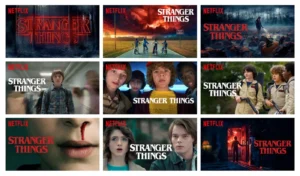
- The Visual Algorithm (Streaming and the Illusion of Choice):
When you log into Netflix, the artwork you see for a movie is rarely the original theatrical poster. It is a dynamically selected, highly optimized thumbnail chosen specifically for your psychological profile.
Consider a massive hit like Stranger Things. The platform generates dozens of distinct visual hooks for the exact same show. If your viewing history leans heavily into horror, your thumbnail might feature a dark, foreboding forest or a close-up of a character with a bloody nose. If you prefer coming-of-age comedies, you might see a bright image of the kids dressed in Ghostbusters costumes. If you watch sci-fi mysteries, you are shown a glowing, ominous portal. You aren’t choosing a show based on a universal cultural artifact; you are responding to a visual trigger custom-engineered to bypass your critical faculties and match your pre-existing data profile. - The Audio Algorithm (Functional Music and Mood Loops):
The music industry is increasingly dominated by “functional audio”—music designed not for deep listening, but to optimize a specific state of mind (focus, calm, hype). Generative AI models produce endless streams of lo-fi beats and formulaic pop hooks perfectly tailored to mood loops, analyzing behavioral data to generate the exact frequency required to keep a user studying or scrolling. The music is a manufactured utility. - The Tactile Algorithm (Ultra-Fast Fashion):
The traditional fashion cycle was dictated by human designers forecasting trends. Today, ultra-fast fashion brands utilize AI to scrape social media, analyzing millions of posts to detect micro-trends. The AI generates hundreds of design variations—many of which have never physically existed—and pushes them to digital storefronts. The AI isn’t responding to human demand; it is generating trend variations before humans even know they want them. - The Chemical Algorithm (Engineered Consumption):
Major conglomerates are utilizing AI to design flavors based on predictive consumption data. AI models predict how specific chemical combinations will trigger neuro-chemical rewards, designing snacks and beverages that hit our biological sweet spots with mathematical precision. We are no longer tasting reality; we are tasting a pre-filtered simulation of it.
Three Tensions of the Algorithmic Age
This is not merely a technology story about the optimization of supply chains or the efficiency of neural networks. It is a profoundly human story about agency. As AI transitions from predicting to constructing our reality, it forces us to confront three critical tensions.
1. Agency vs. Optimization: The Illusion of Choice
Free will in the digital age is rapidly becoming a philosophical luxury. For decades, we celebrated the internet as the ultimate engine of agency—a boundless library where we were the curators of our own experience. But as platforms shifted from hosting content to algorithmically generating and filtering it, the architecture of choice fundamentally changed.
Are we actually choosing the media we consume, the clothes we wear, and the food we eat, or are we simply walking down a carefully constructed, invisible corridor?
When an AI generates a customized menu of options, all of which are mathematically optimized to appeal to your specific psychological vulnerabilities and historical data, the act of “choosing” becomes a semantic technicality. We are trading our cognitive agency for frictionless optimization. You may feel in control because you are the one clicking the button, but the platform owns the choice architecture. In a system optimized entirely for yield—be it watch-time, click-through rates, or purchases—your agency is just another variable to be managed, predicted, and gently steered. This is the ultimate triumph of AI manufacturing preferences: making you believe the manufactured choice was entirely your own.
2. Creativity vs. Convergence: The Blanding of Everything
Why does everything look, sound, and feel increasingly artificial? The answer lies in the mathematical mechanics of machine learning itself. Generative AI models and recommendation algorithms operate on probability; they are designed to predict the most statistically likely next word, the most probable next pixel, or the most successful chord progression.
By definition, they optimize for the mean. They seek the path of least resistance and maximum engagement. When AI generates or heavily filters content based on historical data of what “works,” it inherently shaves off the rough edges, the avant-garde risks, and the polarizing eccentricities that define true human creativity. The algorithm cannot compute the value of a brilliant mistake.
The result is a cultural convergence—a global “blanding” where architecture, interior design, music, and writing all regress toward a highly polished, universally acceptable, completely sterile aesthetic. We see this in the proliferation of “AirSpace”—the global, minimalist coffee shop aesthetic that looks identical whether you are in Tokyo or Toronto.
Worse still, this convergence creates a recursive loop of mediocrity. Human creators, desperate to survive in an algorithmically governed economy, begin mimicking the machine. They study the metrics, reverse-engineer the AI’s preferences, and alter their own art to appease the algorithm. The AI then scrapes this newly homogenized human output as training data for its next generation of models, compounding the sameness. It feels artificial because it is devoid of the friction and unpredictable fingerprints of human flaw that give art its soul.
3. Identity vs. Algorithm: Who Are We Becoming?
“You are what you consume” is a foundational tenet of modern identity. Historically, the cultivation of taste was an active, sometimes arduous journey of self-discovery. Finding an obscure band, developing a unique sense of style, or championing a niche author required effort, trial, error, and social interaction. Your taste was the boundary of your identity; it was how you signaled who you were to the rest of the world.
But if taste defines identity, and taste is now actively constructed by external, profit-driven algorithms… who are we actually becoming?
We are increasingly outsourcing the curation of our identities to machines. When Spotify wraps up your year and tells you what your specific “vibe” is, or when TikTok’s algorithm rapidly categorizes you into a hyper-specific micro-trend, you aren’t discovering yourself. You are adopting a packaged, algorithmically assigned demographic bucket. You are conforming to a predictive model’s estimation of who you should be. The algorithm holds up a funhouse mirror, and we contort our identities to match the reflection.
If your preferences are continuously shaped by a Taste Feedback Factory, the line between the self and the system blurs into nothingness. We are moving from a society of individuals forming subcultures to a society of data points being herded into optimized behavioral clusters. The ultimate casualty of the synthetic era may not just be original art, but the original self.
The Big Question
The artificiality we sense in the modern world is not an illusion; it is the physical manifestation of a society that has outsourced its cultural curation to machines. We have built an incredibly efficient engine for giving people exactly what they want, only to realize that the engine now decides what we want in the first place.
We must ask ourselves if the friction of human experience—the act of searching, the frustration of a difficult piece of art, the challenge of a truly novel idea—is a bug to be optimized away, or the very feature that makes us human. If we allow the era of AI manufacturing preferences to run unchecked, we will live in a world of infinite, perfectly tailored content, but we will have lost the ability to create anything truly new.
We once consumed culture. Now, culture is being computed for us—one preference at a time.