
Distinction Bias: Why Everything Seems Better in Comparison
You are choosing between two job offers. Laid side by side in a spreadsheet, the differences feel enormous — one pays $8,000 more annually, has slightly faster career progression, and offers a marginally better benefits package. You spend three weeks agonizing. You make elaborate pros-and-cons matrices. You lose sleep.
Two years into the job you chose, you cannot remember which offer had the better dental plan. The $8,000 difference, once it dissolved into lifestyle, turned out to change almost nothing about your daily experience of being alive. The differences that dominated your decision had almost no impact on your life. The decision that felt so consequential was, in the architecture of lived experience, nearly irrelevant.
This is the Distinction Bias — one of the most quietly consequential cognitive biases in decision making, and one of the least discussed.
What is Distinction Bias
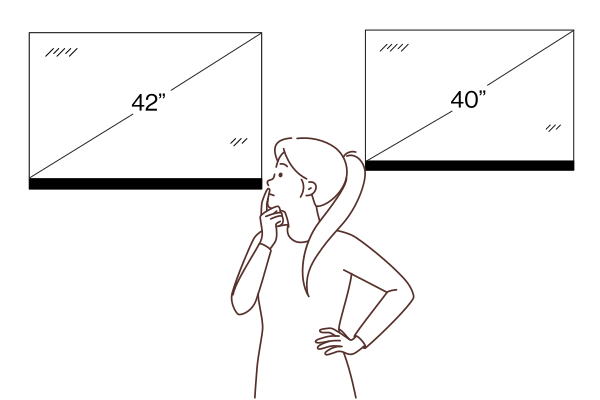
The Distinction Bias, identified by behavioral economists Christopher Hsee and Jiao Zhang, describes our tendency to overweight the differences between options when we evaluate them simultaneously (joint evaluation) compared to when we experience them separately (separate evaluation). In direct comparison, even trivial differences become magnified. In lived experience, those same differences shrink to near-invisibility.
The bias is not about making wrong choices — it is about making choices under the wrong cognitive conditions. We evaluate in comparison mode but live in experience mode. These two modes produce systematically different assessments of the same reality.
The OS Analogy
The Human OS has two distinct evaluation protocols: Comparative Mode and Experiential Mode. Comparative Mode is triggered when options are available simultaneously. It is a differential processor — it scans for differences and amplifies them, because differences are what matter when choosing. Experiential Mode is what runs after the choice is made. It measures absolute quality — not how this compares to the alternative, but how this feels in use.
The Distinction Bias is what happens when Comparative Mode runs at full power during a decision — amplifying every difference — but Experiential Mode, which will actually govern the post-choice reality, would have weighted those same differences as nearly zero.
The system is optimized for choosing, not for living with what was chosen. And this mismatch between the choosing-self and the experiencing-self is where the bias does its most damage.
Why It Exists
Comparative evaluation is, in most circumstances, an excellent cognitive strategy. When your ancestors needed to choose between two hunting grounds, two potential shelters, or two food sources, the ability to identify and prioritize differences was directly adaptive. The brain evolved to be exquisitely sensitive to comparison — to relative rather than absolute value.
The problem is that this comparison machinery is poorly calibrated to modern, complex decisions where the differences being amplified often exist on dimensions that do not map to experiential quality. Salary differences that look enormous in a spreadsheet dissolve in hedonic adaptation. Feature differences between products that dominate a review session become invisible after a week of use. The brain compares with great precision and often with great irrelevance.
Where It Shows Up Today
Consumer electronics purchasing is almost entirely governed by Distinction Bias. Side-by-side comparison tools on retail sites — deliberately engineered to trigger Comparative Mode — amplify every difference in processor speed, camera resolution, and display refresh rate. The user’s Comparative Mode runs hot. The actual experiential difference between a 120Hz and 144Hz display, in daily use, is imperceptible to most humans.
Dating apps structurally embed the Distinction Bias into the evaluation of human beings. When potential partners are presented side-by-side (swiping creates an implicit comparison), differences that would be imperceptible in real-world interaction become decisive. This may be one reason why app-matched couples report less satisfaction than they expected: Comparative Mode overvalued differences that Experiential Mode never actually detects.
In UX and product design, A/B testing platforms put teams in perpetual Comparative Mode. A button that performs 3% better in a test environment becomes a strategic priority. The teams become connoisseurs of differences that users will never consciously register.
In hiring, Distinction Bias causes interviewers who see multiple candidates in sequence to overweight comparative differences (who gave the slightly better answer to question 4?) over absolute quality (is this person actually good enough for this role?).
The Hidden Cost
The deepest cost of Distinction Bias is the opportunity cost of over-deliberation. When trivial differences appear enormous in Comparative Mode, people spend cognitive and temporal resources — real, finite resources — agonizing over decisions whose outcomes will be experientially indistinguishable.
There is also an emotional cost: post-decision regret that is generated not by the choice itself, but by the memory of the comparison. Because the difference loomed so large during evaluation, it continues to loom large in retrospect. People don’t just make hard decisions — they suffer over them, and then continue suffering even when the outcome is fine, because the magnitude of the deliberation implied a magnitude of consequence that never materialized.
Design Insight
For product designers and strategists, Distinction Bias is both a warning and an opportunity. As a warning: features that look compelling in comparison testing may add no experiential value — and may actively burden users with complexity they won’t benefit from. The question to ask is not “does this feature win in comparison?” but “will users experience this feature as valuable in actual use?”
As an opportunity: designers who understand Distinction Bias can architect evaluation environments that activate Experiential Mode rather than Comparative Mode. This means showing products in use-context rather than feature-grids, using narrative and scenario-based presentations over side-by-side specs, and building in “experience simulations” (free trials, demos, test drives) that let users access Experiential Mode before committing.
The most honest product presentation is not the one that wins comparisons. It is the one that accurately previews the experience of living with the product.
How to Work With It (Not Against It)
Separate before comparing. When making a major decision, evaluate each option independently before placing them in direct comparison. Write down your assessment of Option A before you see Option B. This gives Experiential Mode a chance to register before Comparative Mode takes over.
Ask the “one year later” question. Before finalizing a decision, ask: “A year into this, which of these differences will I still notice?” This activates prospective Experiential Mode and correctly downgrades many comparison-salient differences.
Design for the post-choice state, not the choosing state. In product strategy: ask what the user will experience after the excitement of the new purchase fades. Build for that state.
Reduce comparison surface. Where possible, limit the number of simultaneously visible options. This is not about obscuring information — it is about presenting information in a sequence that prevents Comparative Mode from running unchecked.
Closing Insight
The Distinction Bias is a reminder that the Human OS has two modes of knowing: the knowing of comparison and the knowing of experience. They speak different languages. They weight different things. And they almost never agree.
Most of modern life is structured to trigger Comparative Mode — every marketplace, every dating app, every feature matrix. The rarer, more subversive skill is to access Experiential Mode before the decision is made. To ask not “which is better?” but “what will it be like to live inside this?”
The best choices are not the ones that win comparisons. They are the ones that sustain experience.