

The Ultimate Guide to the Eisenhower Matrix: Master Time Management and Prioritize Like a Pro
In today’s fast-paced world, it is easy to feel overwhelmed by an endless to-do list. You might find yourself working constantly, putting out fires all day, yet feeling like you haven’t accomplished anything meaningful by the time you clock out. If you are struggling to manage your time effectively, the Eisenhower Matrix is the ultimate productivity framework to help you regain control.
Also known as the Urgent-Important Matrix, this powerful time management tool helps you categorize tasks based on their urgency and importance. By dividing your workload into four distinct quadrants, the matrix allows you to filter out the noise, focus on high-impact work, and eliminate time-wasting activities.
Whether you are a project manager, an entrepreneur, a student, or simply someone trying to balance work and life, the Eisenhower Matrix can transform how you approach your daily routine.
What is the Eisenhower Matrix?
The Eisenhower Matrix is named after Dwight D. Eisenhower, the 34th President of the United States and a five-star general during World War II. Known for his incredible productivity and ability to make tough decisions under pressure, Eisenhower famously noted: “I have two kinds of problems, the urgent and the important. The urgent are not important, and the important are never urgent.”
Decades later, author Stephen Covey popularized this concept in his highly acclaimed book, The 7 Habits of Highly Effective People, turning Eisenhower’s decision-making process into the four-quadrant visual framework we use today.
The core philosophy is simple: Not all tasks are created equal. By separating tasks that demand immediate attention (Urgent) from tasks that contribute to your long-term goals (Important), you can allocate your time and energy exactly where it matters most.
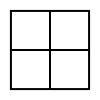
The Four Quadrants of the Eisenhower Matrix
To use the matrix intuitively, you must evaluate every task on your to-do list and place it into one of four quadrants. Here is a detailed breakdown of how each quadrant works:
Quadrant 1: DO (Urgent + Important → DO IT NOW )
The “Firefighting” Quadrant Tasks in this quadrant are emergencies, looming deadlines, and critical issues that demand your immediate attention. These are the things you must Do First today. If you ignore them, there will be immediate negative consequences.
- Examples: A server crash on your website, a client demanding a project that is due in an hour, a medical emergency, or a crying baby.
- Action Plan: Do these tasks immediately. However, your goal should be to reduce the number of tasks that end up here by better planning in Quadrant 2.
Quadrant 2: SCHEDULE (Important + Not Urgent → SCHEDULE IT )
The “Growth” Quadrant This is the most critical quadrant for long-term success, yet it is the one we most often neglect. These tasks do not have a ticking clock, but they directly contribute to your personal or professional goals, growth, and well-being.
- Examples: Strategic planning, skill development, networking, exercising, preventive maintenance, and deep work.
- Action Plan: Schedule time for these tasks on your calendar. Highly effective people spend most of their time in this quadrant, preventing important tasks from becoming urgent emergencies.
Quadrant 3: DELEGATE (Urgent + Not Important → DELEGATE IT)
The “Distraction” Quadrant Tasks in Quadrant 3 are the ultimate productivity killers. They require immediate attention, but they do not align with your core goals or require your specific expertise. Often, these tasks are important to someone else, not you.
- Examples: Most emails, unnecessary meetings, minor favors for coworkers, and ringing phones.
- Action Plan: Delegate these tasks to someone else whenever possible. If you cannot delegate, try to automate them or push back politely. Protect your time.
Quadrant 4: ELIMINATE (Not Urgent + Not Important → DELETE IT )
The “Waste” Quadrant These activities offer no value. They do not help you achieve your goals, nor do they press you for time. They are simply habits, escapes, and time-wasters that drain your productivity.
- Examples: Mindless scrolling on social media, binge-watching TV shows when you should be working, organizing your desk for the fifth time, and gossiping.
- Action Plan: Eliminate or drop these tasks entirely. While everyone needs downtime to relax, these activities should not be confused with true restorative rest (which belongs in Quadrant 2).
Also read : Productive Thinking Model
How to Implement the Eisenhower Matrix Effectively
Understanding the matrix is only half the battle. Here are a few best practices to ensure you are using it intuitively on a daily basis:
- Limit Your Tasks: Don’t overload the matrix. Try to limit each quadrant to a maximum of 7-8 tasks. If you have too many items in Quadrant 1, you will quickly experience burnout.
- Color-Code for Clarity: Use colors to visually distinguish your priorities. For instance, use Red for Do, Blue for Schedule, Yellow for Delegate, and Gray for Eliminate.
- Assess Relentlessly: Before writing a task down, stop and ask yourself: “Is this actually important, or just urgent?” Be honest with yourself about what truly moves the needle.
- Do it the Night Before: Plan your matrix at the end of the workday for the following day. This allows you to wake up with a clear, stress-free action plan.
Frequently Asked Questions (FAQs)
1. What is the difference between “Urgent” and “Important”?
Answer: Urgent tasks require immediate action—they come with a strict deadline and immediate consequences if ignored (e.g., a ringing phone). Important tasks contribute to your long-term mission, values, and goals (e.g., studying for an exam). Urgent tasks are reactive; important tasks are proactive.
2. What if I work alone and cannot delegate tasks in Quadrant 3?
Answer: If you are a solo entrepreneur or student without a team, “delegating” can take other forms. You can use software to automate tasks (like scheduling social media posts or setting up email auto-responses), hire a low-cost freelancer for administrative work, or simply batch these tasks together and do them at the end of the day when your energy is lower.
3. Is it normal to spend all my time in Quadrant 1?
Answer: Many people find themselves trapped in Quadrant 1, but it is not sustainable and leads to burnout. If you are constantly putting out fires, you need to dedicate more time to Quadrant 2 (planning and prevention) to stop emergencies before they happen.
4. Can a task change quadrants over time?
Answer: Absolutely. If you put off a Quadrant 2 task (Important, Not Urgent)—like writing a report due in a month—it will eventually move into Quadrant 1 (Important and Urgent) as the deadline approaches.
5. Are Quadrant 4 tasks always bad?
Answer: Not necessarily! True rest and relaxation are vital for your mental health and belong in Quadrant 2. However, mindless procrastination or habits that make you feel drained rather than recharged belong in Quadrant 4 and should be minimized during your productive hours.