
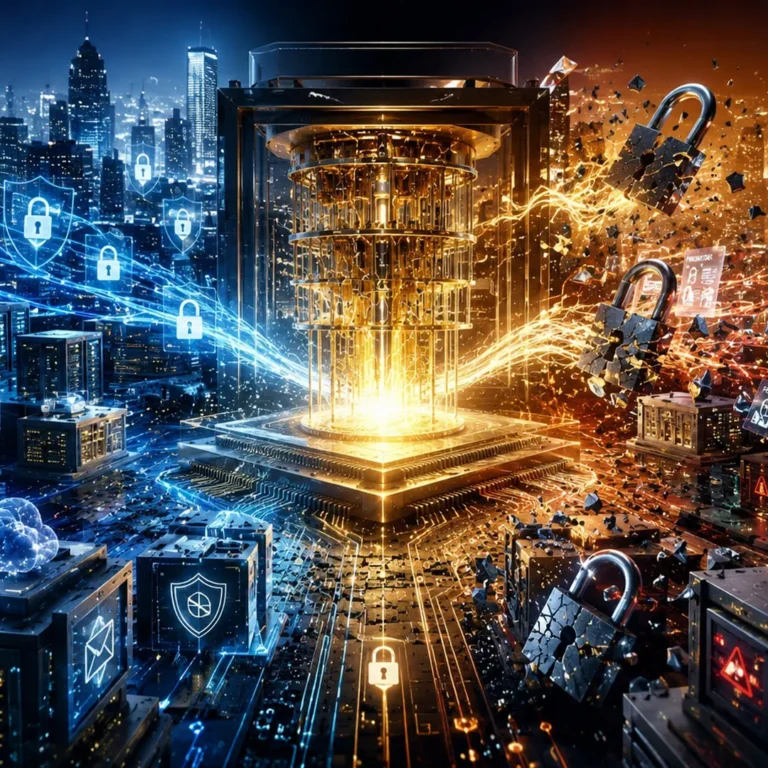
What is Q Day? The Quantum Computing Moment That Could Break the Internet
Imagine waking up one morning to discover that the encryption protecting bank accounts, government secrets, healthcare records, cryptocurrency wallets, and online communications no longer works. The padlock icon next to your web browser address bar is meaningless. Corporate databases are laid bare, military satellite links are exposed, and global financial transactions stall in an instant.
This is not the plot of a dystopian sci-fi novel. It is the defining nightmare scenario of modern cybersecurity, a theoretical milestone known to technology strategists, national intelligence agencies, and physicists simply as Q Day.
As quantum computing transitions out of the lab and into the industrial tech sector, the timeline for this cryptographic reckoning is shrinking. What was once dismissed as a problem for the late 21st century has become an urgent boardroom priority. At the World Economic Forum, technology leaders openly compared the current trajectory of quantum computing to where Artificial Intelligence stood just five years ago—right on the precipice of an exponential explosion.
To prevent a structural collapse of digital trust, we must first decode the physics, the math, and the systemic risks of the impending quantum era.
What Is Q Day?
At its core, Q Day is a capability milestone. It is defined as the specific moment when a cryptographically relevant quantum computer (CRQC) achieves the scale and stability required to break widely used public-key encryption algorithms.
Unlike a traditional calendar deadline—such as the Y2K bug, which possessed a mathematically absolute expiration date—Q Day is a floating target. The term was coined by cybersecurity experts and quantum physicists to crystallize a complex engineering race into a single, high-stakes concept. They use it to signal that the security of our infrastructure is tied to a moving evolutionary curve in physics, rather than a fixed date on a timeline.
The risk is binary: our current systems are either secure against quantum computation or they are completely broken. Because the transition to quantum-safe alternatives takes years, the countdown to Q Day effectively started yesterday.
Why Today’s Internet Depends on Encryption
To understand why Q Day is so dangerous, we have to look at how the modern internet protects information. The entirety of digital commerce, privacy, and sovereignty relies on public-key cryptography.
When you log into your bank account, send an encrypted message, or access a secure corporate cloud, your device uses two distinct keys:
- A Public Key: Available to anyone, used to encrypt the data.
- A Private Key: Held secretly by the recipient, used to decrypt the data.
This architecture generally relies on two primary mathematical systems: RSA (Rivest-Shamir-Adleman) and ECC (Elliptic Curve Cryptography). These systems work because they are built around one-way mathematical traps. For instance, RSA relies on the extreme difficulty of factoring incredibly large numbers into their prime components.
For a classical supercomputer, calculating these prime factors is a grueling process of elimination. If you use a sufficiently long key (like RSA-2048), it would take a traditional computer billions of years—longer than the age of the universe—to guess the private key. This mathematical impossibility is what keeps digital certificates valid, secure web browsing (HTTPS) functional, and government communications confidential.
How Quantum Computers Change the Game
Quantum computers do not just operate faster than classical computers; they process information using an entirely different set of rules based on quantum mechanics.
Classical Bit:  [0] OR [1]  --> Processes linearly (one by one)
Quantum Qubit:  [0] AND [1] --> Processes exponentially (all at once via Superposition)
Traditional computers rely on bits, which represent data as either a 0 or a 1. Quantum computers use qubits (quantum bits). Thanks to a physics phenomenon known as superposition, a qubit can exist in a state of 0, 1, or both simultaneously. Furthermore, through entanglement, qubits can link with one another across a system. This allows a quantum computer to map out an exponential number of mathematical pathways all at once.
When a quantum device achieves quantum advantage—the point where it can solve problems no classical computer can handle in a reasonable timeframe—it changes everything for cryptography.
Shor’s Algorithm: The Master Key
In 1994, a mathematician named Peter Shor published a theoretical quantum algorithm. Shor’s Algorithm proved that a sufficiently powerful quantum computer could solve prime factorization and discrete logarithms almost instantly.
By running Shor’s Algorithm, a quantum computer can work backward from a public key to deduce the private key in a matter of hours, or even minutes. This dismantles the fundamental mathematical trapdoor that RSA and ECC depend on. If the math becomes easy, the lock falls open.
What Happens on Q Day?
If the global transition to quantum-resistant infrastructure is incomplete when Q Day hits, the societal and economic disruption will be systemic.
- Financial Market Shock: The trust layer of global banking would evaporate. If digital signatures can be forged, clearinghouses cannot verify multi-billion-dollar transactions, stock trades could be manipulated, and ATM networks would go offline to prevent unauthenticated withdrawals.
- Critical Infrastructure Failure: Modern power grids, water treatment plants, and transportation networks rely on secure operational technology (OT). Forged digital certificates could allow attackers to issue malicious firmware updates directly to critical valves, turbines, and switches.
- Corporate Exposure: Enterprise intellectual property, proprietary source code, and commercially sensitive communications would become transparent. Corporate espionage would scale to an existential degree.
- The Collapse of Sovereign Security: Diplomatic cables, military troop movements, and intelligence briefs sent via encrypted channels would become completely visible to adversarial states.
The “Harvest Now, Decrypt Later” Threat
The most critical misconception about Q Day is that the danger lies entirely in the future. In reality, the operational risk is already unfolding through a strategy known as Harvest Now, Decrypt Later (HNDL).
[Today: Intercept & Store] ---> [Intercepted Encrypted Data] ---> [Future: Q Day Arrives] ---> [Retroactive Decryption]State-sponsored hacking groups and sophisticated threat actors are not waiting for functional quantum computers to build their archives. They are actively intercepting and storing massive volumes of deeply encrypted enterprise and government data right now.
An adversary cannot read a harvested database today, but they can patiently warehouse it in massive server farms. When they finally construct or buy access to a cryptographically relevant quantum computer, they will feed this legacy data through Shor’s Algorithm.
This means that any data with a long shelf-life—such as national security blueprints, biometric records, corporate trade secrets, and lifelong healthcare data—is already compromised if it remains protected only by classical public-key encryption.
Also read : What is Explorecore
Industries Most Vulnerable to Q Day
Not all sectors face the same exposure profile. The vulnerability of an industry depends on two variables: the operational lifespan of its infrastructure and how long its data must remain confidential.
| Industry Sector | Primary Quantum Risk Profile | Impact Level | Critical Vulnerability |
|---|---|---|---|
| Defense & Government | Decryption of legacy intelligence, compromise of tactical field communications, and falsified military command structures. | Critical | Long-term operational data longevity (30+ years). |
| Banking & Finance | Breakdown of transaction validation, identity verification, automated clearinghouse (ACH) routing, and smart contract security. | Critical | High volume of real-time asset transfers and financial records. |
| Cryptocurrency | Shor’s algorithm can derive private keys from public addresses, allowing attackers to drain legacy wallets (especially Bitcoin and Ethereum). | Critical | Irreversible transactions on public distributed ledgers. |
| Healthcare | Exposure of private electronic health records (EHR) and genomic data, which must remain confidential for the patient’s lifetime. | High | High data shelf-life combined with slow legacy software migration. |
| Telecommunications | Eavesdropping on satellite, fiber-optic, and cellular routing tables; breakdown of over-the-air firmware updates. | High | Deeply embedded hardware that is physically difficult to patch. |
| Cloud Computing | Compromise of multi-tenant hypervisors, automated API endpoints, and customer-managed encryption keys. | High | Interdependent supply chain; single point of failure for thousands of enterprises. |
| E-Commerce | Forgery of merchant certificates, session hijacking, and theft of payment credentials during transit. | Medium | Short lifespan of individual transactions, but massive consumer scale. |
How Close Are We to Q Day?
Estimating the arrival of Q Day requires tracking two competing trends: quantum hardware scaling and algorithmic optimization.
Historically, physicists argued that breaking RSA-2048 would require a machine with millions of physical qubits to account for quantum noise and environmental decoherence. Because today’s advanced systems generally operate with only a few hundred or thousand noisy qubits, many assumed Q Day was decades away.
However, recent breakthroughs have challenged that comfort zone:
- Algorithmic Efficiency: In early 2026, research papers from institutes like Caltech and Google Quantum AI highlighted new error-correction architectures that drastically reduce the physical hardware footprint required for complex calculations. Instead of millions of physical qubits, optimized architectures could potentially run cryptographic attacks with far fewer logical qubits.
- Capital Acceleration: Quantum computing has graduated from academic research into a primary geopolitical priority. The U.S. Commerce Department recently funneled more than $2 billion under the CHIPS and Science Act specifically into domestic quantum foundries, including a $1 billion initiative for IBM to construct a pure-play superconducting quantum wafer foundry. Similar state-backed initiatives are accelerating across Europe, China, and India.
The Realistic Timeline
- The Aggressive View (2028–2030): Tech firms pushing commercial roadmaps argue that engineering velocity and rapid error-correction breakthroughs could yield a cryptographically relevant machine by the turn of the decade.
- The Conservative View (2032–2040): Pragmatic physicists note that scaling physical systems while maintaining stable quantum coherence remains a monumental engineering hurdle, suggesting a 10-to-15-year runway.
Regardless of which timeline proves correct, the consensus among cybersecurity experts is unanimous: waiting for a definitive breakthrough to begin migration is a catastrophic strategic error.
What Is Post-Quantum Cryptography?
The defense against the quantum threat does not involve building a quantum computer of your own. Instead, it requires replacing our current mathematical trapdoors with new ones that are too complex for both classical and quantum systems to solve. This field is known as Post-Quantum Cryptography (PQC).
The global focal point for this defense is the U.S. National Institute of Standards and Technology (NIST). After a rigorous, multi-year international review process, NIST began finalizing its official PQC standards:
- FIPS 203 (ML-KEM): Based on the CRYSTALS-Kyber algorithm, this is the primary standard for general encryption. It handles key encapsulation mechanisms, which secure the initial handshakes for web browsing and data exchange.
- FIPS 204 (ML-DSA): Based on CRYSTALS-Dilithium, this standard serves as the primary tool for digital signatures, ensuring that identities and data integrity can be verified securely.
- FIPS 205 (SLH-DSA): Utilizing a stateless hash-based approach (SPHINCS+), this algorithm serves as a sturdy backup option in case future mathematical discoveries expose vulnerabilities in lattice-based math.
Most of these finalized standards rely on lattice-based cryptography. This framework hides data inside complex, multi-dimensional geometric structures that contain billions of points. Finding a specific point within this lattice requires solving a problem that Shor’s Algorithm cannot easily optimize, keeping the mathematical barrier firmly in place.
What Businesses Should Do Today
Migrating an enterprise network away from traditional public-key cryptography is a complex infrastructure project that cannot be accomplished overnight. Business leaders should approach quantum readiness through a systematic, five-step framework:
- Conduct a Cryptographic Inventory
You cannot protect what you cannot see. Enterprises must deploy automated discovery tools to map out exactly where RSA, ECC, and other vulnerable public-key algorithms are currently being used across their databases, applications, cloud environments, and third-party SaaS integrations. - Require Cryptographic Bills of Materials (CBOMs)
Every procurement team should mandate that software and hardware vendors provide a comprehensive CBOM. This documentation explicitly outlines the encryption algorithms embedded within their products, allowing you to quickly spot vulnerabilities in your supply chain. - Build for Crypto-Agility
Security environments should not be rigid. Systems must be re-architected to support crypto-agility—the structural capacity to rapidly swap out cryptographic algorithms without breaking the underlying application logic or requiring a full system overhaul. - Implement Hybrid Deployment Models
Rather than executing a risky, all-at-once migration to PQC, organizations should deploy hybrid encryption models. This approach wraps data in two layers: a classical algorithm (like RSA) to maintain current regulatory compliance, and a new NIST-approved PQC algorithm (like ML-KEM) to defend against the quantum threat. - Establish Leadership Accountability
Quantum readiness should not be buried deep within a standard IT checklist. Executive teams must assign direct ownership of the migration roadmap to the CISO or a dedicated quantum risk task force, backed by clear capital allocation and regular board updates.
Beyond Security: The Broader Impact of Q Day
While Q Day is fundamentally framed as a security crisis, the technological advancements driving it will trigger massive positive breakthroughs across broader society.
The exact same computational capabilities that can dismantle an RSA key will unlock unprecedented potential in other fields. In Artificial Intelligence, quantum processing will allow models to calculate massive, multi-dimensional neural networks instantaneously, pushing machine intelligence past current limitations.
In the fields of chemistry and medicine, quantum simulation will allow scientists to model molecular interactions at an atomic level. This will collapse drug discovery timelines from decades to days and pave the way for highly efficient synthetic materials, next-generation batteries, and breakthroughs in clean energy.
Ultimately, Q Day is much more than a looming IT disruption. It is a fundamental test of our ability to anticipate systemic risk and modernize our global infrastructure before the disruption arrives. The organizations and nations that build a foundation of quantum resilience today will protect their assets and position themselves to lead the impending quantum economy.
FAQ Section
What is Q Day?
Q Day is the predicted future point when a cryptographically relevant quantum computer becomes advanced enough to break the standard public-key encryption algorithms (like RSA and ECC) currently used to secure the internet.
When is Q Day expected to happen?
While exact timelines vary based on hardware development and error-correction breakthroughs, most industry experts and intelligence agencies estimate that Q Day could arrive somewhere between the late 2020s and the mid-2030s.
Can quantum computers really break encryption?
Yes, but specifically public-key (asymmetric) encryption. By running Shor’s Algorithm, quantum computers can easily solve the complex mathematical equations that keep these systems secure. They do not instantly break symmetric encryption (like AES-256), which remains highly resilient if implemented with proper key lengths.
Is the internet prepared for Q Day?
Not yet, but the transition is officially underway. Tech platforms, cloud providers, and browsers are actively integrating the newly finalized NIST post-quantum cryptography standards into their systems to protect infrastructure ahead of time.
What is post-quantum cryptography?
Post-quantum cryptography (PQC) refers to new, advanced encryption algorithms engineered to secure data against attacks from both classical supercomputers and quantum computers. Most of these new standards rely on complex multi-dimensional geometric frameworks known as lattice-based cryptography.
Which industries face the highest risk?
Sectors that rely on long-term data confidentiality and deeply embedded legacy infrastructure face the highest risk. This includes government, national defense, banking, financial services, healthcare, and telecommunications.
Should individuals worry about Q Day?
Individual users do not need to take manual security steps right now. The responsibility for quantum migration rests with the software developers, financial institutions, device manufacturers, and cloud infrastructure companies that build and maintain our digital ecosystem.
How are governments preparing?
Governments are treating quantum security as a matter of national sovereignty. Initiatives like the U.S. Quantum Computing Cybersecurity Preparedness Act mandate that federal agencies inventory their systems and actively migrate to NIST-approved post-quantum encryption standards