The Creative Thinking Framework

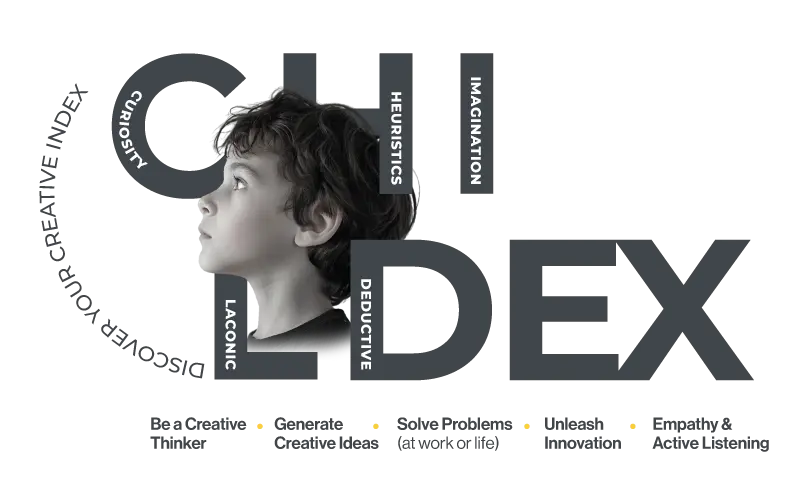
The CHILD Framework

Five interconnected traits that turn scattered creativity into a system you can actually run. Watch any child meet a new problem and you’ll see the pattern — curiosity, exploration, imagination, clear expression, reasoning — looping into breakthrough after breakthrough. This is that loop, made practical for grown-ups. Scroll to walk it.

C

Curiosity

The seed of every creative thought

Core principle

Curiosity isn’t just asking questions — it’s asking the right question at the right moment. The best innovators use structured inquiry to surface opportunities everyone else walked straight past.

Put it to work

Master the 5-Why technique to dig past symptoms to root causes. Map the assumptions quietly limiting your thinking. Build curiosity triggers that switch on fresh thinking even in routine situations.

In the wild

Curiosity carried James Dyson through 5,126 failed prototypes. He simply kept asking why vacuums lose suction — and rebuilt an entire industry around the answer.

What you’ll build

  • Strategic questioning that reveals opportunities
  • Assumption-challenging that breaks conventional thinking
  • Systematic exploration that de-risks new ideas
  • Better problems, found before better answers
H

Heuristics

The art of simplifying complexity

Core principle

Heuristics are the mental shortcuts expert problem-solvers reach for on instinct. Instead of starting from a blank page every time, you learn the patterns that lead reliably to good solutions.

Put it to work

Sharpen pattern recognition to spot solution templates that already work. Practise analogical thinking to carry an insight from one industry into another. Turn constraints into creative fuel rather than obstacles.

In the wild

Pattern recognition is how Netflix saw the shift from DVDs to streaming before anyone else — and built the future while competitors defended the present.

What you’ll build

  • Pattern recognition that speeds up solutions
  • Cross-industry insight transfer
  • Turning constraints into advantages
  • Mental models for consistent creative output
I

Imagination

The fuel for what doesn't exist yet

Core principle

Imagination here isn’t daydreaming — it’s the disciplined practice of exploring what could be, paired with the craft to make those visions real, tangible, and valuable.

Put it to work

Use scenario planning to rehearse multiple futures. Practise visualisation that makes abstract ideas concrete enough to share. Map the possibility space so creative sparks become actionable options.

In the wild

Walt Disney could see an entire guest journey before a single brick was laid — imagining complete experiences that created whole new categories.

What you’ll build

  • Future-scenario development for strategy
  • Making abstract concepts concrete
  • Possibility-space exploration
  • Design-thinking for user-centred innovation
L

Laconic

Saying more with far less

Core principle

Laconic thinking strips away everything unnecessary to deliver maximum impact in minimum words. Precision becomes a creative advantage — it’s what makes a good idea adoptable.

Put it to work

Learn distillation techniques that extract the essence from complexity. Build clarity frameworks that make new ideas instantly graspable. Communicate with the precision that actually moves people to act.

In the wild

Steve Jobs distilled complex technology into a handful of unforgettable words. That clarity, more than the tech itself, drove adoption at a scale the industry had never seen.

What you’ll build

  • Simplifying complex ideas for wider appeal
  • Precision communication that drives decisions
  • Identifying the essence worth focusing on
  • Message clarity that speeds adoption
D

Deductive

The anchor that grounds ideas in logic

Core principle

Deductive reasoning isn’t rigid logic that kills creativity — it’s the foundation that lets others follow, understand, and build on your ideas for consistent, repeatable breakthroughs.

Put it to work

Combine systematic thinking with creative method. Reduce randomness without killing spontaneity. Use structured approaches that let a team generate reliable results, not just lucky ones.

In the wild

Toyota’s lean system turned creative problem-solving into a repeatable discipline — a systematic approach so sound that industries worldwide adopted it.

What you’ll build

  • Systematic innovation for consistent results
  • Logical creativity that scales across teams
  • Structured processes that reduce risk
  • Creative methods others can replicate

How the five work together

Curiosity finds the opportunity. Heuristics point to an efficient path. Imagination stretches it past the obvious. Laconic thinking makes it clear enough to spread. And Deductive reasoning turns it into something repeatable others can follow. Run it once, you get an idea. Run it as a loop, you get a practice.

Discover your Creative Index

Which of the five is your superpower?

CHILDex turns the framework into a mirror — a quick read on where your creative thinking runs strongest, and where it’s ready to grow.

Explore CHILDex
CHILDex — discover your creative index
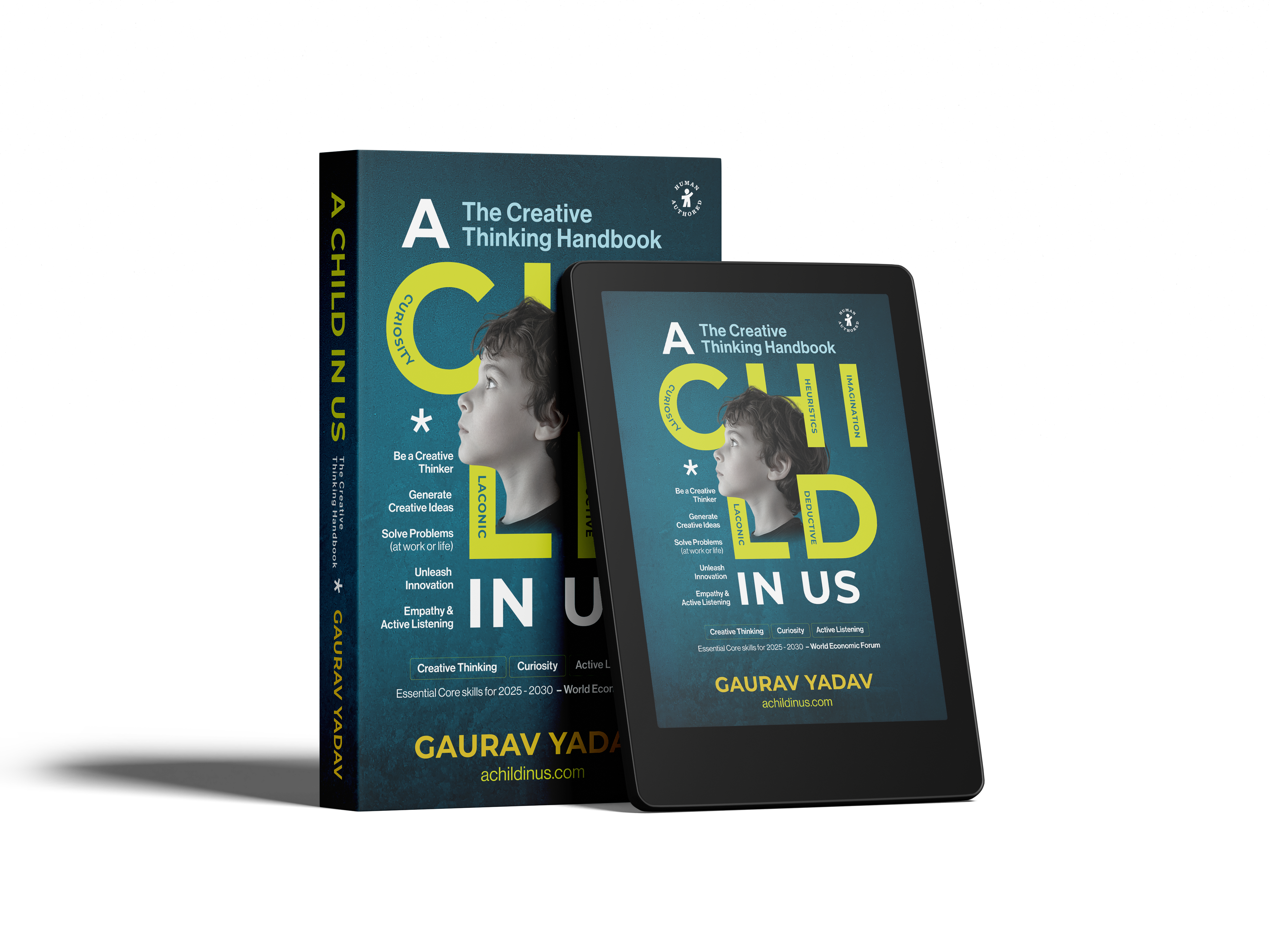
A CHILD in US: The Creative Thinking Handbook by Gaurav Yadav
The handbook

A CHILD in US

The Creative Thinking Handbook — the full framework, the exercises, and the system, in one human-authored book by Gaurav Yadav.

Essential core skills for 2025–2030 — World Economic Forum.

CHILD Framework FAQs

The CHILD Framework is a practical, research-based creative-thinking system combining Curiosity, Heuristics, Imagination, Laconic communication, and Deductive reasoning to help individuals and teams solve problems and spark innovation.

It breaks creativity into five actionable traits, guiding you to generate ideas, question assumptions, and refine solutions using proven creative problem-solving techniques rather than waiting for inspiration to strike.

Anyone building creative and innovation skills, including students, professionals, educators, and business teams. It works equally well for individuals and for collaborative groups.

It integrates five proven traits into one loop, grounded in research such as the World Economic Forum's Future of Jobs report, targeting the creative skills most in demand today.

Apply the CHILD traits to brainstorm ideas, analyse workflow challenges, build better products, and open fresh perspectives on strategic projects, turning everyday challenges into innovation opportunities.

Yes. As automation grows, human creativity becomes the number-one skill for future-proofing a career, and the CHILD Framework focuses on exactly that kind of innovation-skills development.

Start with the five traits here, then go deeper with the creative-thinking handbook, "A CHILD in US", for practical exercises and the full system.

Advertisement