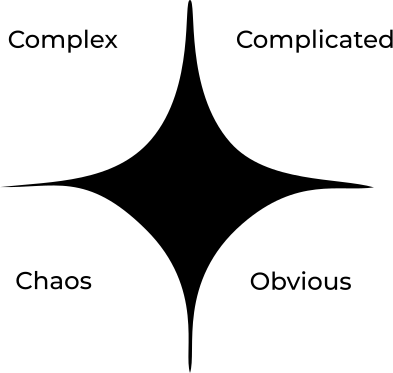

The Cynefin framework sorts problems into five domains — Clear, Complicated, Complex, Chaotic, and Confused — because the response that solves one kind of problem actively makes another kind worse.
Developed by Dave Snowden, the Cynefin framework’s core move is diagnostic, not prescriptive: before you act, identify which domain you’re actually in.
Where the Cynefin Framework Comes From
Snowden introduced the model in a 2007 Harvard Business Review article co-written with Mary Boone, arguing that executives keep applying the wrong playbook because they misdiagnose which kind of problem they’re facing, not because they lack expertise. The article went on to win an Academy of Management award and remains one of the most cited HBR pieces on decision-making, precisely because the failure it names — treating a genuinely unpredictable situation as if it were merely difficult — keeps recurring in new forms.
The Five Domains of the Cynefin Framework
- Clear — cause and effect are obvious. Sense, categorize, respond. Best practice applies.
- Complicated — cause and effect exist but require expertise to see. Sense, analyze, respond. Good practice, expert judgment.
- Complex — cause and effect are only clear in hindsight. There is no right answer to analyze your way to. Probe, sense, respond — run small experiments, watch what emerges, amplify what works.
- Chaotic — no discernible cause and effect. Act first to establish stability, then sense and respond.
- Confused — you don’t know which domain you’re in. The most dangerous state, because it’s invisible from inside.
The response that solves a Complicated problem actively makes a Complex one worse.
Why Leaders Misapply the Cynefin Framework
The most common failure is treating a Complex problem — most organizational change, most market disruption, most “people” problems — as if it were Complicated, commissioning more analysis, hiring more experts, building a more detailed plan, when what the situation actually calls for is a small, safe-to-fail experiment. The instinct is understandable: Complicated problems reward exactly this kind of rigor, and most executives were trained on Complicated problems. But no amount of additional analysis reveals the “right answer” to a Complex problem, because in the Complex domain the right answer doesn’t exist yet — it emerges from what you try.
Most organizational change is Complex, not Complicated — but it keeps getting managed like a spreadsheet problem.
Cynefin Framework in Practice
A manufacturing defect with a traceable cause is Complicated: bring in the right specialist, and the fix follows. A culture initiative meant to change how a thousand people collaborate is Complex: no consultant can hand you the org chart that guarantees it works, because the outcome depends on how people actually respond once it’s live — which nobody can fully predict in advance. Treating the second problem like the first is why so many change programs produce a beautiful deck and no actual change.
When to Use the Cynefin Framework
Before committing resources to a strategy, ask which domain the problem lives in. A five-minute Cynefin check prevents months of applying “best practice” playbooks to situations where no best practice exists yet.
Before you commit resources, ask which domain you’re actually in. That single question prevents most bad strategy.
Also read: OODA Loop · Pre-Mortem Analysis · The Imperfection Economy