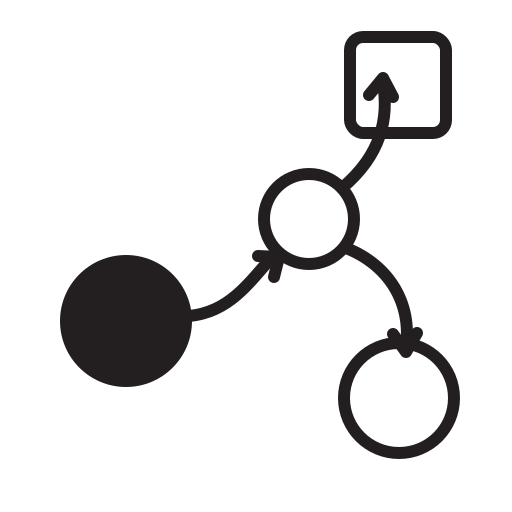

Second-order thinking is the practice of asking “and then what?” — tracing the consequences of a decision beyond its immediate effect to the effects that follow from that effect.
First-order thinking stops at the obvious outcome. Second-order thinking keeps going: what happens next, what happens after that, and how other people respond once the first consequence has landed. Most bad decisions in organisations are not made by people who reasoned poorly. They are made by people who reasoned correctly and then stopped one step too early.
Where second-order thinking comes from
The clearest modern articulation belongs to investor Howard Marks, who used it to explain why consensus positions rarely produce above-average returns. His argument was that first-level thinking is simplistic and nearly everyone can do it — which is precisely why it cannot generate an advantage. If a conclusion is available to everyone who glances at the problem, it is already priced into whatever you are deciding about.
The underlying idea is much older. It runs through Frédéric Bastiat’s distinction between what is seen and what is unseen in economics, through the sociologist Robert K. Merton’s work on unintended consequences, and through systems thinking’s insistence that interventions produce feedback rather than outcomes.
What Marks added was the competitive framing: this mode of reasoning is not just more accurate, it is where the differentiated answer lives. Anyone can identify the first consequence. Advantage comes from correctly reading the second and third.
How second-order thinking works
The mechanism is a repeated question applied to your own conclusion.
First order: We cut prices, so we win more customers.
Second order: And then what? Competitors match within a quarter, margins compress across the category, and we have taught our customers to wait for discounts.
Third order: And then what? We cannot fund the product improvements that justified the original price, so the discount becomes permanent.
The first statement is not wrong. Cutting prices does win customers. It is simply incomplete in a way that inverts the conclusion — a move that looks like growth at order one looks like structural margin damage by order three.
Three questions do most of the work:
- And then what happens? The direct sequel to the outcome you predicted.
- Who responds, and how? Competitors, employees, customers, and regulators all adapt. Any prediction that assumes a static environment is a first-order prediction.
- What does this teach people? Decisions are precedents. They train the people affected by them to expect something, and that expectation becomes the new baseline.
Most bad decisions are not made by people who reasoned poorly. They are made by people who reasoned correctly and then stopped one step too early.
Second-order thinking vs first-order thinking
The critical distinction is not intelligence. It is stopping point. First-order thinking is what the mind does by default, because it is fast and usually adequate for simple problems. It requires consciously refusing the first satisfying answer.
- Question asked — First order: what will this do? Second order: and then what?
- Time horizon — First order: immediate. Second order: across subsequent reactions.
- Assumption — First order: others hold still. Second order: others adapt.
- Effort — First order: low and nearly automatic. Second order: deliberate and slow.
- Availability — First order: obvious to everyone. Second order: where differentiation lives.
Worked examples
Hiring a specialist to fix a bottleneck. First order: the bottleneck clears. Second order: the team routes all related work to that person, who becomes the new bottleneck and the only person who understands the system. Third order: their departure risk is now a business continuity risk.
Adding a productivity metric. First order: the measured activity increases. Second order: unmeasured activity that mattered decreases, because attention is finite. Third order: the metric stops correlating with the outcome it was chosen to represent, and now misinforms decisions.
Automating a routine task. First order: the task gets cheaper and faster. Second order: nobody learns to do it manually, so nobody can evaluate whether the automated output is correct. Third order: the organisation’s ability to supervise its own automation quietly erodes.
A generous remote-work policy. First order: retention improves and the talent pool widens. Second order: informal knowledge transfer that relied on proximity declines. Third order: junior development slows, because most of it was ambient rather than scheduled.
Notice that in every case the first-order effect is real and positive. Second-order thinking rarely reveals that a decision was stupid. It reveals what the decision costs, which is a different and more useful thing.
Second-order thinking rarely reveals that a decision was stupid. It reveals what the decision costs.
When to use second-order thinking
It is expensive in attention, so applying it universally is itself a first-order error. Reserve it for decisions that are:
- Hard to reverse. Consequences you cannot undo deserve consequences you have traced.
- Systemic. Anything touching incentives, metrics, pricing, or org structure produces adaptive responses by definition.
- Popular. If everyone agrees immediately, the first-order case is probably obvious and the second-order case is probably unexamined.
- Precedent-setting. The first exception to a rule is never really about that exception.
For reversible, contained, low-stakes decisions, first-order thinking is correct and anything more is procrastination wearing a respectable coat.
The danger: how second-order thinking gets misused
This is the section most explanations skip, and it matters more than the technique.
Infinite regress. There is no natural stopping point. Every consequence has consequences, and confidence degrades sharply with each step — a third-order prediction is often a guess dressed as analysis. Practical rule: stop when your next-order prediction depends on more assumptions than the decision itself.
Sophisticated paralysis. The most common failure in organisations. Second-order objections can be raised against any proposal, they always sound wiser than enthusiasm, and they cannot be disproved in advance. This makes the technique an extraordinarily effective tool for people who want to block things while appearing thoughtful. If your analysis always concludes “so we shouldn’t”, you are not analysing. You are rationalising.
Ignoring the cost of inaction. Doing nothing also has downstream consequences, and they are almost never subjected to the same scrutiny. The comparison must be like for like: the second-order effects of acting against the second-order effects of not acting.
Contrarianism as a substitute. Because this kind of reasoning often overturns the obvious answer, people begin assuming the obvious answer is always wrong. It usually is not. The point is to check the consensus, not to invert it reflexively.
Post-hoc justification. The most damaging misuse. A decision gets made on instinct or interest, and the reasoning is constructed afterwards to justify it. The test of genuine use is whether the analysis has ever changed your mind. If it has only ever confirmed what you already wanted, it is decoration.
How to build the habit
Write the prediction down before deciding — first-order effect, second-order effect, and what would have to be true for each. Specify who reacts and how. Set a review date and check what actually happened.
That last step is the one people skip and the only one that builds the skill. The skill improves through calibration, not through effort. You get better by discovering which of your downstream predictions were wrong and why, which requires having recorded them in a form specific enough to be scored.
Also read
- Pre-Mortem Analysis — a structured way to force this kind of reasoning
- The Iceberg Model — the systems-thinking sibling
- First Principles Thinking — reasoning down vs reasoning forward
- The Seniority Trap — the automation example, worked out in full